
Why Most Beginners Struggle in Tae Kwon Do Before They Even Notice It
Starting Tae Kwon Do feels exciting at first—new uniforms, powerful kicks, and fast-paced drills. But within a few weeks, many beginners hit the same invisible wall. Their techniques don’t feel stable, their kicks lose power, and sparring becomes overwhelming.
The truth is that most early struggles don’t come from lack of effort but from repeating small technical mistakes. These issues quietly build up and eventually affect performance, confidence, and even motivation.
A coach once shared a story about a new student who trained hard for two months but couldn’t pass basic grading. The problem wasn’t effort—it was stance instability and poor balance control that no one corrected early enough.
1. Weak or Unstable Fighting Stance That Breaks Everything Else
Why stance is the foundation of Tae Kwon Do
A weak stance is one of the most common Tae Kwon Do beginner mistakes. Without a stable base, every movement—kicks, punches, and blocks—loses structure. Beginners often stand too upright or too narrow, making them easy to push off balance.
How it shows up in real training
You might notice yourself wobbling during kicks or stepping backward unintentionally during sparring. One beginner described it as “feeling like I’m on ice skates every time I try to kick.”
Fast correction method
Focus on lowering your center of gravity slightly and keeping feet shoulder-width apart. Practicing slow shadow drills improves muscle memory faster than repetitive fast kicking.
2. Incorrect Kicking Form That Reduces Power and Control
Why beginners lose power even when they try hard
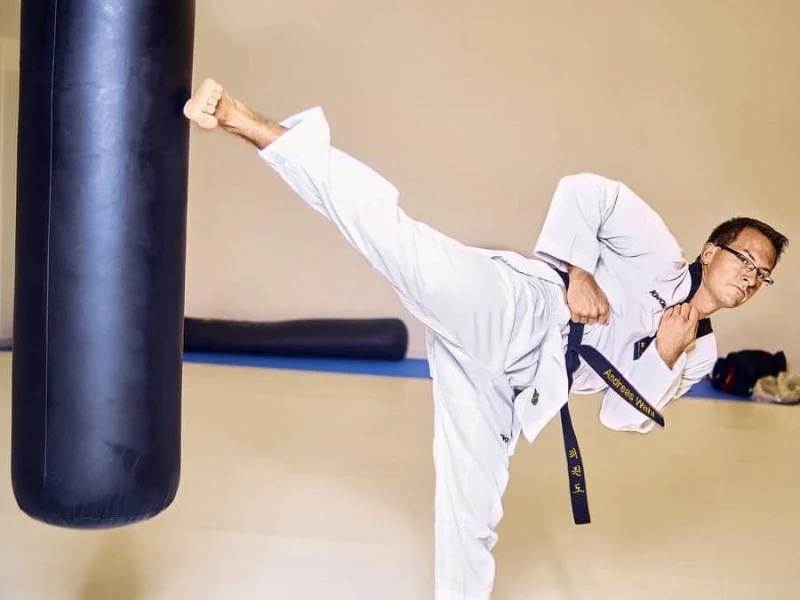
A common issue in taekwondo training tips is improper hip rotation. Many beginners kick with just the leg instead of engaging the full body.
Real training example
In one beginner class, two students were asked to break boards. The stronger-looking student failed because he didn’t rotate his hips. The smaller student succeeded because his technique was cleaner and more aligned.
Correction approach
Break down kicks into three stages: chamber, rotation, and extension. Practicing each slowly builds muscle coordination and improves kicking form correction.
3. Dropping Guard and Leaving the Head Unprotected
Why it happens
Beginners often focus too much on attacking and forget defense. This leads to lowered hands and exposed openings.
Impact during sparring
Even light contact sparring becomes frustrating because repeated head taps break confidence. Many beginners assume they are “bad at sparring,” when in reality their guard positioning is the issue.
How to fix it quickly
Train with a mirror or partner drills that enforce guard discipline. Repetition is key until keeping hands up becomes automatic.
4. Flat-Footed Movement That Slows Everything Down
Why footwork matters more than power
Good martial arts footwork errors often come from beginners planting their feet too heavily. This removes agility and makes movement predictable.
Common scenario in class
A beginner stands still, waits for an attack, and reacts too late. Advanced students instead glide, shift angles, and control distance.
Training adjustment
Light bouncing drills and directional stepping exercises help rebuild mobility. Over time, movement becomes smoother and more responsive.
5. Improper Breathing That Causes Early Fatigue
Hidden problem most beginners ignore
Many beginners hold their breath during kicks or tense up during sparring. This leads to exhaustion much faster than expected.
Real experience from training
One student described feeling “completely drained after just two rounds,” even though others continued comfortably. The issue wasn’t fitness—it was breathing rhythm.
Fixing the rhythm
Exhale sharply during strikes and inhale during resets. This keeps oxygen flow steady and improves endurance.
6. Over-Aggressive Sparring Without Control
Why beginners rush too much
Excitement often leads beginners to attack constantly without structure. This reduces technique quality and increases mistakes.
Training observation
In beginner sparring sessions, the fastest attacker often loses because they abandon defense and timing.
Better approach
Focus on controlled sparring where technique matters more than speed. Precision builds long-term effectiveness.
7. Ignoring Flexibility and Mobility Training
Why flexibility is not optional
High kicks require controlled flexibility. Without it, beginners compensate with poor form or reduced range.
Common mistake pattern
Skipping stretching leads to stiffness, which directly affects kicking height and recovery speed.
Improvement strategy
Daily mobility routines focusing on hips and hamstrings significantly improve performance within weeks.
8. Inconsistent Practice and Weak Mental Discipline
Why mindset determines progress
Even with good technique, inconsistent training slows development. Discipline is what transforms beginners into advanced practitioners.
Real-world pattern
Many students train intensively for two weeks, then pause for several days, losing momentum each time.
Long-term correction
Short, consistent practice sessions are more effective than occasional long workouts. Building habit strength is key.
How Real Students Turn Mistakes Into Fast Progress
In many Tae Kwon Do schools, including training environments like Jeuns TKD Hub, instructors often notice that progress accelerates dramatically once these eight mistakes are corrected.
One student who struggled for months improved rapidly after focusing only on stance stability and breathing control. Within four weeks, sparring confidence improved noticeably.
This shows that improvement doesn’t always require more effort—sometimes it requires correcting what is already being done.
Building a Smarter Training Mindset
Tae Kwon Do is not just physical repetition. It is structured skill development. Every kick, step, and breath contributes to long-term mastery.
When beginners focus on correcting foundational mistakes early, progress becomes smoother, faster, and more enjoyable. Training becomes less about frustration and more about steady improvement.

 Aikido of San Jose4.0 (7 reviews)
 Nikko Jujitsu School4.0 (9 reviews)
 Gracie Barra San Clemente Martial Arts4.0 (47 reviews)
 Karate Institute of America4.0 (4 reviews)
 Keweenaw Korean Martial Arts0.0 (0 reviews)
 Wing Chun School of Internal Arts5.0 (6 reviews)
 How to Execute a Jumping Roundhouse Kick to the Head
 How to Execute a Double Kick Combination in Sparring
 How to Perform a Flawless Axe Kick: A Step-by-Step Guide
 DIY Tae Kwon Do Training Equipment for Home Practice
 How to Increase Your Vertical Jump for Tae Kwon Do Flying Kicks
 The History of the Tae Kwon Do Peace Corps