
Tae Kwon Do Sparring Gear Check Before Every Practice
On this page
- Quick answer
- Start with your school and event rules
- Inspect every protective item
- Check fit before contact begins
- Test electronic scoring equipment
- Pack a reliable sparring bag
- Watch for gear problems during practice
- Clean and store equipment safely
- Safety and medical boundaries
- Frequently asked questions
- Conclusion and pre-practice checklist
Quick answer
Before sparring, confirm the exact gear required by the instructor or event, inspect every shell, strap, fastener, seam, sensor, and mouthguard, then put everything on and test the fit through basic movement. Replace cracked, stretched, sharp, loose, contaminated, or unreliable equipment. Keep nails trimmed, remove prohibited jewelry, and stop immediately if gear shifts, breaks, exposes a hard edge, or no longer protects the intended area.

Gracie Humaita Hemet / gracie humaita hemet
HemetRiverside CountyCalifornia
2164 E Florida Ave, Hemet, CA 92544, USA
Start with your school and event rules
Protective requirements vary by age, contact level, school curriculum, sanctioning body, and competition. Club practice equipment is not automatically approved for a tournament, and tournament gear is not permission to increase contact beyond the coach's instruction.
The USA Taekwondo competition rules page publishes current kyorugi rules plus equipment and hygiene requirements. It showed updated 2026 material when reviewed in July 2026. World Taekwondo competition rules identify categories such as trunk and head protection, groin guard, forearm and shin guards, gloves, sensing socks when used, and a mouthguard for covered competition. Local events may modify rules, especially for youth divisions.
Before practice or travel, ask:
- Which governing rules and version apply?
- Does equipment need a particular approval mark?
- What head-contact, face-shield, color, and age rules apply?
- Are electronic protectors or sensing socks supplied or personal?
- What jewelry, taping, braces, religious items, and medical supports are allowed?
Inspect every protective item
Lay equipment out in the order it will be worn. Check it in bright light and with clean hands.
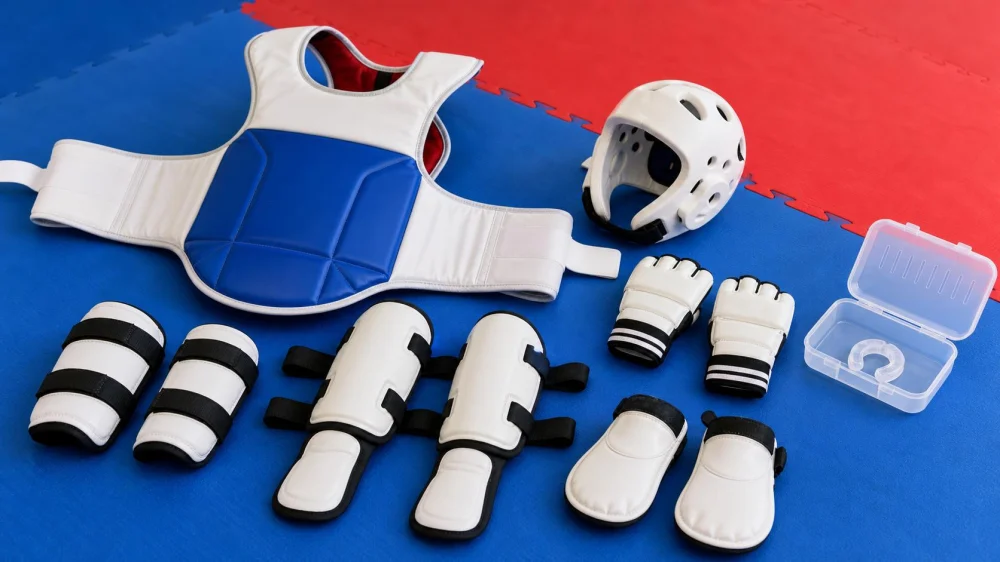
- Head protector: Look for cracks, compressed foam, torn padding, loose closures, exposed hard edges, and a distorted opening.
- Trunk protector: Check the outer surface, shoulder and back straps, seams, closure points, and any electronic components.
- Forearm and shin guards: Inspect shells, padding, elastic, hook-and-loop fasteners, stitching, and left/right placement.
- Gloves: Check palm and finger openings, padding, wrist closure, seams, and any rough or split surface.
- Groin guard: Inspect the cup, edges, fabric, and waistband; wear it in the position required by the rules and manufacturer.
- Foot or sensing protection: Look for holes, stretched bands, loose sensors, debris, and poor grip.
- Mouthguard: Check for tears, sharp edges, thinning, poor retention, odor, and contamination.
Do not tape over structural cracks, add improvised hard pieces, or share personal equipment without an approved hygiene process. Ask the instructor to evaluate uncertain damage.

Giordano's ATA Martial Arts / giordano's ata martial arts
MurrietaRiverside CountyCalifornia
24540 Village Walk Pl, Murrieta, CA 92562, USA
Check fit before contact begins
- Put equipment on over the required uniform in the correct order.
- Secure straps firmly without restricting breathing or circulation.
- Turn the head, raise the arms, chamber each knee, step, pivot, and perform light non-contact footwork.
- Confirm guards cover the intended area and do not rotate, slide, pinch, or create a trip hazard.
- Check that vision and hearing remain adequate for coach and referee instructions.
- Ask a coach to confirm placement before the first contact round.
Gear that is too large can shift; gear that is too small can leave areas uncovered or compress tissue. Children's equipment should be checked regularly as they grow rather than selected only by belt level or age label.
Test electronic scoring equipment
Electronic protector and scoring systems require event-specific compatible equipment. Follow the organizer and manufacturer instructions for charging, pairing, sensor placement, approved socks, and pre-match testing.
- Charge authorized components before arrival.
- Keep connectors, sensors, and fabric clean and dry.
- Do not bend, cut, modify, or privately repair sealed electronics.
- Test the assigned system during the official check period.
- Report failure to the coach or official rather than striking harder to “make it score.”
Scoring response is not a measure of whether a training strike was safe. Practice intensity remains under coach control.
Pack a reliable sparring bag
Use a ventilated bag with separate clean and used sections. A practical checklist includes:
- Every required protector and approved uniform
- Fitted mouthguard in a ventilated case
- Water bottle with a secure cap
- Clean towel and change of clothing
- Small approved hygiene supplies
- Any instructor-approved brace or medical item
- Event membership, identification, and rules information when traveling
- A separate bag for damp equipment after practice
Label the bag discreetly so similar school equipment is not exchanged. Do not leave medication, electronics, or heat-sensitive equipment in a hot vehicle.
Watch for gear problems during practice
Both partners should pause when a strap loosens, guard rotates, mouthguard falls out, hard edge appears, or equipment interferes with breathing, vision, balance, or communication. Step back, signal the coach, and wait for contact to stop before adjusting anything.
Replace equipment rather than continuing when:
- A shell, cup, or rigid component is cracked
- Padding stays compressed or exposes a hard point
- Closures repeatedly open during ordinary movement
- Blood or bodily fluids cannot be cleaned under the facility protocol
- A mouthguard is torn, sharp, loose, or cannot be retained
- Electronic equipment overheats, swells, smells unusual, or fails inspection
Protective gear reduces some risk; it does not make uncontrolled contact safe.
Clean and store equipment safely
- Follow each product's cleaning instructions; materials and electronics differ.
- Wipe or wash permitted surfaces promptly after use.
- Air-dry equipment completely away from direct high heat and pets.
- Open straps and remove guards from a sealed bag.
- Clean the mouthguard separately and store it in a ventilated case.
- Inspect again after drying, when cracks and loose stitching are easier to see.
- Store in a clean, cool, dry area without heavy objects compressing the padding.
Do not use bleach, fragrance, adhesive, or heat unless the manufacturer specifically permits it. Never place electronic protectors in water.
Safety and medical boundaries
This is general equipment education, not a replacement for instructor supervision, event rules, manufacturer instructions, or medical care. Sparring should occur only in a suitable facility with matched partners, explicit contact rules, and a qualified coach.
Stop after a head impact, suspected concussion, severe pain, breathing difficulty, eye injury, dental injury, faintness, numbness, weakness, or loss of balance. Seek urgent medical help for emergency symptoms. Do not return to contact based on how the gear looks or because symptoms briefly improve.
World Taekwondo's Safeguarding Policy emphasizes a safe, respectful, athlete-centered environment free of harassment and abuse. Report unsafe pressure, retaliation, or inappropriate contact through the applicable school and SafeSport channels.
Frequently asked questions
Can I use tournament gear for regular class?
Ask the instructor. Approved competition gear may be acceptable, but class drills, contact rules, and hygiene procedures can require something different.
How often should sparring gear be replaced?
There is no universal schedule. Replace it when manufacturer limits are reached or inspection shows loss of fit, padding, closure, hygiene, or structural integrity.
Can teammates share head or trunk protectors?
Follow the facility's hygiene policy and product instructions. Mouthguards and other personal-contact items should not be shared.
Should a loose guard just be tightened more?
Not if the size or elastic is wrong. Excess tightening can restrict movement or circulation. Choose a better-fitting item.
Does more padding allow harder sparring?
No. Contact level comes from the drill, athlete development, coach, and rules. Padding does not eliminate brain, joint, dental, or soft-tissue injury risk.
Conclusion and pre-practice checklist
Verify current rules, inspect every item, test fit through movement, confirm electronics, and ask the coach before contact. Stop for shifting or damaged gear, clean equipment promptly, and replace anything that cannot protect and remain hygienic. A two-minute inspection supports safer practice for both partners.

 Premier Martial Arts Swampscott5.0 (70 reviews)
 1802 Jiu-Jitsu5.0 (31 reviews)
 White Dragon Judo4.0 (47 reviews)
 Steele Creek Martial Arts5.0 (12 reviews)
 South Bay Shotokan4.0 (5 reviews)
 ATA Martial Arts- St. Peters4.0 (20 reviews)
 How to Execute a Jumping Roundhouse Kick to the Head
 How to Execute a Double Kick Combination in Sparring
 How to Perform a Flawless Axe Kick: A Step-by-Step Guide
 DIY Tae Kwon Do Training Equipment for Home Practice
 How to Increase Your Vertical Jump for Tae Kwon Do Flying Kicks
 The History of the Tae Kwon Do Peace Corps