
Tae Kwon Do Nails and Jewelry: Check Before Partner Drills
Table of contents
Quick answer
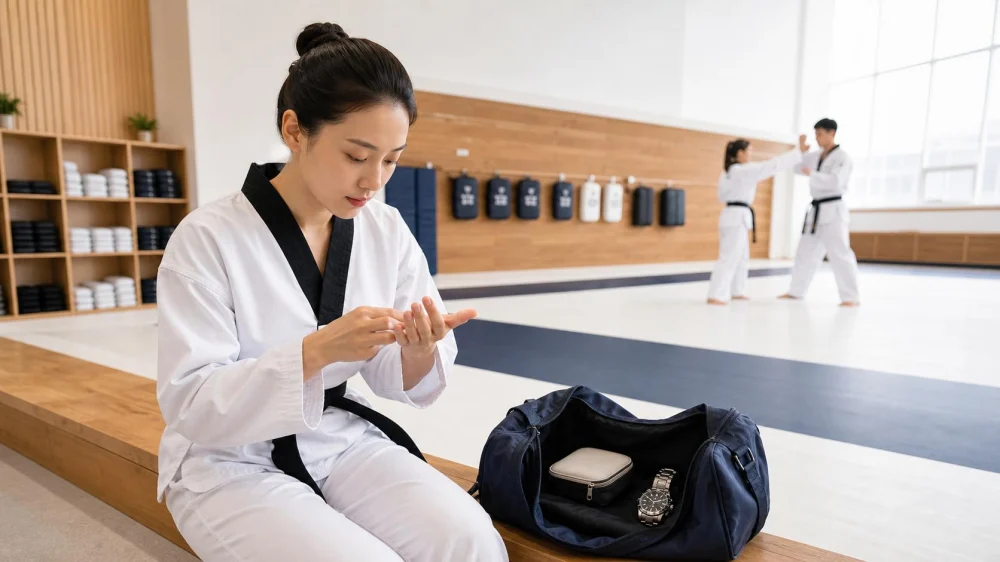
Before partner work, check that fingernails and toenails are short, smooth, clean, and free of sharp breaks. Remove rings, watches, bracelets, necklaces, earrings, hard hair pieces, and other items your school prohibits. Put them in a closed pouch outside the mat area. Tell the instructor about a piercing or medical item you cannot remove before assuming that tape makes it safe.

United Martial Arts Centers Warwick / umac warwick ny
43 West St, Warwick, NY 10990, USA
Why this small check matters
Tae Kwon Do partner drills bring hands, feet, uniforms, targets, and protective gear into close contact. A small sharp edge can scratch skin, catch fabric, press under a glove, or snag during a turn. A hard accessory can also injure its wearer when it is struck or compressed.
The check belongs before warm-up, not when partners are already waiting. Make it part of the same arrival routine as signing in, changing clothes, and inspecting gear. Competition rules and local school rules are not identical, but both can be stricter than ordinary everyday wear.
CKO Kickboxing Sheepshead Bay / cko kickboxing sheepshead bay brooklyn ny
2615 E 17th St, Brooklyn, NY 11235, USA
Check fingernails and toenails
Look at every nail from the front and side. The goal is not a particular cosmetic length; it is an edge that does not extend sharply, split, or catch when a fingertip moves across it. Toenails deserve the same attention because bare feet, foot protectors, kicking shields, and close footwork can create contact.
- Trim at home with clean clippers rather than scattering nail pieces in the changing area.
- File rough corners and inspect broken polish, artificial nails, or extensions for hard edges.
- Wash and dry hands and feet, then check for cuts, torn cuticles, or bleeding.
- Ask the instructor before training if a damaged nail cannot be made smooth and secure.
Do not trim so aggressively that the surrounding skin becomes sore or bleeds. A fresh open wound creates a different problem and should be covered or managed according to the school's hygiene policy.
Remove jewelry and hard accessories
Do a head-to-toe sweep, because familiar items are easy to forget:
- earrings, studs, hoops, chains, and pendants;
- rings, bracelets, fitness trackers, and watches;
- anklets, toe rings, and hard decorative bands;
- metal hair clips, rigid pins, and sharp-edged headbands; and
- keys, pens, or hard objects left in dobok pockets.
A ring can catch a uniform or target, while a necklace can tighten or snag. A watch or tracker can create a hard striking surface even when worn under a sleeve. Flexible religious or medical items may need a school-approved method; discuss them privately with the instructor rather than improvising.
Handle piercings before class
Ask the school about piercings before the first partner session. World Taekwondo competition rules identify piercings, earrings, and other hard material on the face or body as potential safety issues at inspection. A recreational class may have its own process, but competition permission should never be assumed.
Tape is not a universal solution. It can loosen with sweat, fail to remove the hard object underneath, or conceal an item that still presses into tissue. If jewelry cannot be removed because a piercing is new or medically complicated, tell the instructor early. The safest available class modification may be non-contact practice until the issue can be resolved.
Store items so they stay removed
Use a small zippered pouch or divided case inside a locked bag or locker. Put jewelry away before entering the mat instead of leaving it on a bench, water bottle, windowsill, or pile of shoes. Loose objects can be lost, stepped on, or carried back into class accidentally.
Keep nail clippers and a file in a personal hygiene kit, but clean them and do not share them. Add a simple reminder to the outside of the pouch if you frequently forget a watch or ring. After class, wash and dry before putting accessories back on, and check that no item was damaged.
Make the partner check respectful
Each student is responsible for their own preparation, but partners can speak up when they notice a sharp nail, watch, or earring. Use neutral language: “Could we pause and ask the instructor about that ring?” Do not grab another person's hand, jewelry, or clothing to inspect it.
If a partner raises a concern about your equipment, stop and check. The instructor should decide whether an item is permitted or whether the drill needs modification. Avoid dismissing the concern because a previous class allowed the item.
Two-minute pre-class checklist
- Fingernails are short, smooth, and free of sharp breaks.
- Toenails are checked before bare-foot training.
- No nail, cuticle, or skin area is actively bleeding.
- Rings, watches, bracelets, necklaces, and earrings are removed.
- Hard hair accessories and pocket items are removed.
- Non-removable piercings or medical items have been discussed with the instructor.
- Removed items are closed inside a secure pouch away from the mat.
- The final setup follows today's school or event rules.
Limits and injury cautions
This article provides general training-safety information. School policies, competition rules, insurance requirements, religious accommodations, and medical needs differ. Your instructor and the current event rules determine what is permitted in a specific class or tournament.
Do not train through active bleeding, a deep scratch, a torn nail, swelling around a piercing, or signs of infection. Stop contact, notify the instructor, and follow the facility's first-aid and cleaning process. Seek medical care for a significant wound, embedded jewelry, uncontrolled bleeding, or infection concerns.
Frequently asked questions
Can I cover earrings with athletic tape?
Only if the instructor and applicable rules explicitly allow it. Tape does not remove the hard object or guarantee that it cannot snag, so many programs require removal.
Are short artificial nails acceptable?
Ask the school. Length is only one factor; thickness, hard edges, cracks, and the risk of lifting from the natural nail also matter during contact.
Do I need to remove a fitness tracker for forms practice?
Follow the class rule. Even without partner contact, a tracker can affect wrist motion, catch a sleeve, or become a hard object when drills change unexpectedly.
What if I notice a sharp nail after class starts?
Step off the training area with permission and fix it safely, or ask the instructor for a non-contact modification. Do not bite, tear, or clip the nail onto the mat.
Rules and sources
- World Taekwondo: Current Kyorugi Rules and Documents
- World Taekwondo: Competition Rules and Interpretation
- Your school's current student handbook, instructor direction, and tournament inspection instructions are the primary sources for a specific session.
Conclusion and next steps
Make the nail-and-jewelry check automatic: smooth every edge, remove hard accessories, secure them off the mat, and raise exceptions before partner work begins. It takes only a moment and lets both partners focus on timing, control, and technique instead of an avoidable snag.
 MBA Majest Martial Arts Fredericksburg4.0 (64 reviews)
 Joe Goss Karate4.0 (18 reviews)
 TC-TAEKWONDO5.0 (34 reviews)
 Atlanta Kick5.0 (159 reviews)
 Moy Yat Ving Tsun Kung Fu Institute Tampa/Seffner5.0 (8 reviews)
 SA Kids Karate4.0 (43 reviews)
 How to Execute a Jumping Roundhouse Kick to the Head
 How to Execute a Double Kick Combination in Sparring
 How to Perform a Flawless Axe Kick: A Step-by-Step Guide
 DIY Tae Kwon Do Training Equipment for Home Practice
 How to Increase Your Vertical Jump for Tae Kwon Do Flying Kicks
 The History of the Tae Kwon Do Peace Corps