
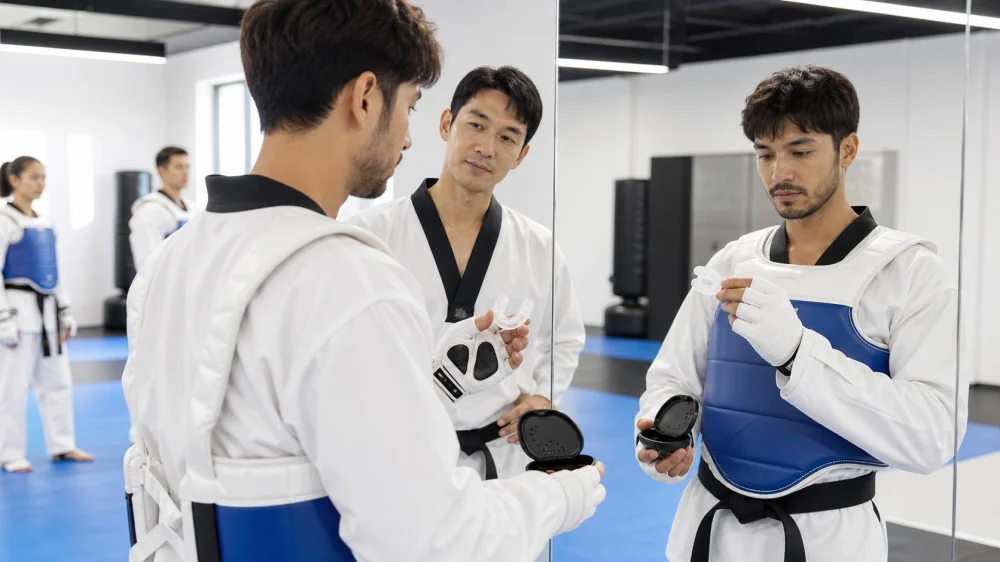
Tae Kwon Do Mouthguard Fit: Check Before Sparring
On this page
Quick answer
A Tae Kwon Do mouthguard should match the school or tournament rules, cover and cushion the intended teeth, stay in place without constant biting, and allow practical breathing and communication. Fit it only by its instructions or through a dental professional, inspect it before sparring, clean and dry it after use, and replace it when torn, loose, sharp, distorted, or no longer compatible with braces or dental changes.
A mouthguard reduces some dental and soft-tissue risk but cannot prevent every mouth, jaw, or head injury.

Budo Martial Arts Studio / budo martial arts studio
Ewing TownshipMercer CountyNew Jersey
9 Scotch Rd, Ewing Township, NJ 08628, USA
Check school and event rules
- Whether a mouthguard is required for the class or competition division
- Permitted colors, designs, materials, and coverage
- Whether braces require a specific orthodontic model
- Inspection procedures at equipment check
- Whether a spare may be carried
- How a lost guard during a match is handled
Competition rules can change by organization, age, rank, and event. Confirm the current event packet rather than assuming the dojang’s everyday gear rule is identical.
Champions Martial Arts Plainview / champions martial arts plainview
PlainviewNassau CountyNew York
10 Washington Ave, Plainview, NY 11803, USA
Fit and retention
A properly fitted upper guard generally stays seated when the mouth opens and does not require chewing to hold it. It should not create sharp pressure, trigger gagging, block normal breathing, or interfere excessively with clear safety commands.
Boil-and-bite fitting requires exact water, heating, cooling, and molding steps. An adult should supervise children. Do not overheat, cut, grind, or repeatedly remold a guard unless the manufacturer says it is designed for that.
Pre-sparring inspection
- Wash and dry hands.
- Check the guard in bright light for tears, splits, thinning, and rough edges.
- Confirm it is clean and free of odor or debris.
- Seat it fully without forcing.
- Open the mouth, breathe, and say the school’s stop cue.
- Confirm it does not interfere with other approved protective gear.
- Show the instructor if anything feels different.
Never borrow another person’s mouthguard or share one between siblings.
Cleaning and storage
Rinse after use and clean by the manufacturer’s method with cool or lukewarm water and an approved gentle cleaner. Hot water can distort many guards. Let it dry as directed and store it in a clean ventilated case protected from pets, heat, and direct sun.
Clean the case too. Do not wrap the guard in a uniform or damp towel, leave it loose in a gear bag, or use harsh chemicals unless expressly approved.
When to replace it
Replace a guard that is cracked, torn, chewed through, deformed, rough, persistently unclean, loose, painfully tight, or no longer retained. Growing athletes may need more frequent fit checks as teeth and jaws change.
Bring the guard to routine dental visits. A dentist can assess wear and whether a custom design or different coverage is appropriate.
Braces and dental work
Braces, retainers, erupting teeth, fillings, crowns, and orthodontic changes can alter fit. Use a guard designed for the current appliance and allow the space recommended by the orthodontist or dentist. Do not force an old guard over new work.
After dental treatment, mouth injury, or a tooth change, pause contact training until the treating dental professional and instructor give appropriate guidance.
Frequently asked questions
Should I wear a mouthguard for non-contact forms practice?
Follow the instructor and school rules; it is most commonly relevant to contact or impact-risk drills.
Can I talk while wearing it?
Some speech change is expected, but essential safety communication should remain practical.
Can I trim a guard that rubs?
Do not alter it unless the manufacturer or dental professional specifically directs the change.
How often should it be replaced?
There is no universal interval. Wear, growth, dental changes, material, and frequency all matter.
Does it prevent concussion?
A mouthguard is primarily dental protection and does not eliminate concussion risk.
Sources and evidence notes
This guide applies sports mouthguard fit, inspection, hygiene, and dental-change principles. Exact gear rules and acceptable designs vary by Tae Kwon Do organization, school, event, and age group.
Use current tournament rules, product instructions, instructor requirements, and advice from a dentist or orthodontist for the athlete.
Conclusion and next steps
Confirm the rule before class, inspect the guard before contact, and test retention, breathing, and the stop cue. Clean, dry, and case it immediately after training. Keep a correctly fitted spare for important events, and involve a dental professional whenever growth, braces, treatment, damage, or discomfort changes the fit.

 Aikido of San Jose4.0 (7 reviews)
 Nikko Jujitsu School4.0 (9 reviews)
 Gracie Barra San Clemente Martial Arts4.0 (47 reviews)
 Karate Institute of America4.0 (4 reviews)
 Keweenaw Korean Martial Arts0.0 (0 reviews)
 Wing Chun School of Internal Arts5.0 (6 reviews)
 How to Execute a Jumping Roundhouse Kick to the Head
 How to Execute a Double Kick Combination in Sparring
 How to Perform a Flawless Axe Kick: A Step-by-Step Guide
 DIY Tae Kwon Do Training Equipment for Home Practice
 How to Increase Your Vertical Jump for Tae Kwon Do Flying Kicks
 The History of the Tae Kwon Do Peace Corps