
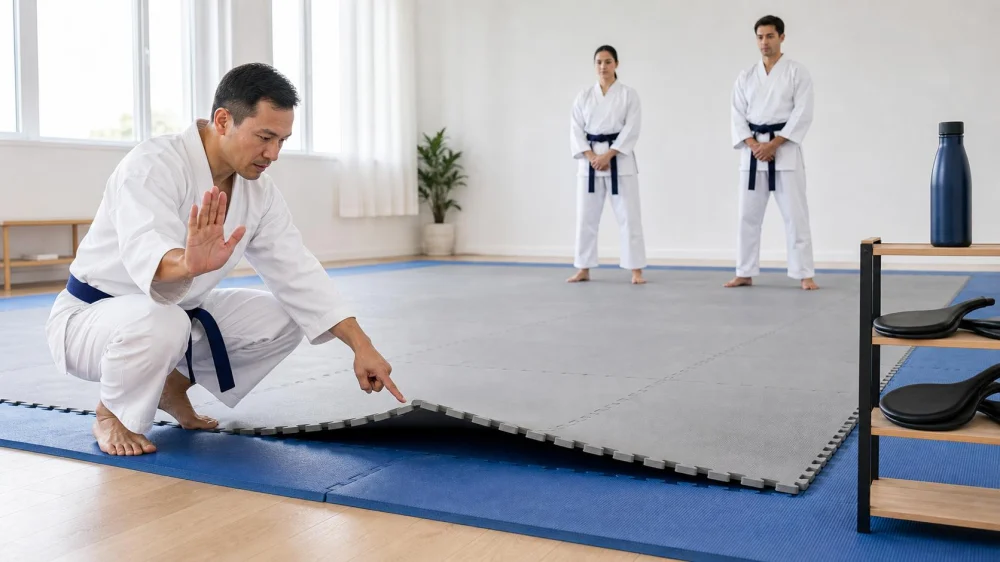
Tae Kwon Do Mat Safety: Check Space and Traction
On this page
- Quick answer
- Pause before entering the floor
- Check the mat surface
- Notice seams, edges, and transitions
- Confirm space and boundaries
- Respond to moisture and debris
- Keep equipment outside the movement path
- Coordinate with partners and nearby groups
- Prepare feet and approved footwear
- Report a hazard without fixing it yourself
- Understand competition-area differences
- Safety limits
- Ten-second floor checklist
- Frequently asked questions
- Evidence and sources
- Next steps
Quick answer
Before Tae Kwon Do practice begins, look for liquid, debris, lifted seams, separated tiles, curled edges, unexpected gaps, obstacles, and people moving through the training path. Tell the instructor or facility staff and wait for them to make the area safe.
Do not tape, rearrange, mop, or repair a mat without authorization. Cleaning chemicals, moisture, incompatible tape, and uneven reassembly can create a new hazard. The coach controls the floor, drill spacing, intensity, and return to practice.

Lead By Example Tae Kwon Do / lead by example tae kwon do
11226 Waples Mill Rd, Fairfax, VA 22030, USA
Pause before entering the floor
Use the school’s entry procedure, then scan the floor before warming up. A mat that was safe at the previous class can change when a tile shifts, a bottle leaks, outdoor grit enters, or equipment is moved.
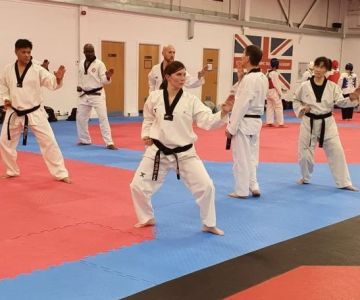
Look across the surface from a low angle when possible. Changes in reflection or height can reveal a wet patch or raised edge. Walk around the boundary rather than stepping into an active drill to inspect it.
Students should report hazards, not become facility technicians. The instructor may close a section, move the class, clean the area with an approved method, or stop practice.

Giroux Bros Martial Arts / giroux brothers
WilbrahamHampden CountyMassachusetts
2400 Boston Rd, Wilbraham, MA 01095, USA
Check the mat surface
World Taekwondo competition rules describe the contest area as flat, free of obstructing projections, and covered by an elastic, non-slippery mat. A local class is not necessarily a competition venue, but those principles offer a useful visual standard.
Watch for:
- wet or glossy patches;
- sand, hair clips, tape scraps, splinters, or grit;
- tears, bubbles, compressed holes, or exposed hard floor;
- tiles with different heights or firmness;
- loose covers or padding that slides;
- cleaner residue or strong chemical odor;
- objects protruding from walls, posts, or floor anchors.
Do not test slipperiness with a fast pivot or kick. Stop outside the questionable area and point it out.
Notice seams, edges, and transitions
Interlocking tiles can separate or buckle. Roll-out mats can develop gaps or lifted tape. A seam may catch a toe during a turn even when it looks small.
Check the path used for running, footwork, poomsae, pad drills, and partner movement. Pay special attention where mat meets wood, concrete, carpet, a wall pad, or another mat thickness.
Edges need a clear buffer. Do not start a kicking or sparring drill with a participant’s heel already near the boundary. Ask the instructor to reset positions or reduce the drill group.
Never pull a tile during class. Reassembly can change alignment across the whole floor, and trapped fingers or an unstable gap can result.
Confirm space and boundaries
The required space depends on the drill, skill level, speed, and number of students. Stationary basics need less room than moving combinations, spinning techniques, board work, or sparring.
Identify the boundaries and the stop command before beginning. Keep doors, stairs, glass, mirrors, spectators, benches, bags, and hard equipment outside the movement path. A padded wall is still a boundary, not a target.
When lines move forward, wait until the person ahead clears the landing and recovery area. Do not assume matching start marks guarantee enough room; bodies and techniques travel differently.
In crowded classes, the instructor may stagger groups, shorten combinations, reduce speed, or assign lanes. Students should not create a faster parallel drill on unused-looking space.
Respond to moisture and debris
Sweat, a leaking bottle, condensation, wet shoes, or an entryway can make a small area slippery. Call “stop” or use the school’s safety signal, keep people away, and alert the instructor.
Facility staff should use the mat manufacturer’s approved cleaning method and allow the surface to dry. An ordinary towel can spread moisture; an unsuitable cleaner may leave residue or damage foam.
Do not spray disinfectant while people train nearby. Products have label directions, contact times, ventilation needs, and material limits. Skin and bare feet should not contact a still-wet environmental disinfectant.
Water bottles belong in the designated area with lids closed. Do not place them beside boundary lines or where a kick can knock them onto the mat.
Keep equipment outside the movement path
Paddles, shields, boards, cones, targets, belts, shoes, and protective gear can become trip hazards. Use a rack or assigned staging zone. Return a dropped item before the next repetition starts.
Inspect handheld targets for loose straps, exposed hard parts, and wet handles. The holder should have stable footing and enough clearance behind them. Broken boards and fragments require a controlled cleanup before bare feet return.
Power cords, tripods, speakers, and cameras should remain outside boundaries and follow school policy. Do not run a cable across an exit or training lane.
Coordinate with partners and nearby groups
Before a partner drill, agree on direction, target, contact level, stop signal, and who initiates. Check the space behind both people, not only between them.
If one pair drifts into another lane, stop and reset. Do not kick through the overlap and expect the other pair to move. Pad holders should not step backward without checking the boundary.
When children and adults share a floor, instructors may separate zones and intensity. Follow the assignment. A smaller student should not be used as a boundary marker or asked to absorb uncontrolled force.
Prepare feet and approved footwear
Many schools train barefoot; others permit or require specific indoor martial-arts footwear for some participants. Follow the instructor and facility rule. Outdoor shoes can carry moisture and grit onto the mat.
Before class, remove sharp jewelry as directed, keep toenails maintained, and cover minor cuts with a secure clean dressing. Do not train barefoot with an uncovered draining wound or a suspected contagious skin condition. Ask a healthcare professional and the school about safe return.
Socks alone can reduce traction on some surfaces. Do not wear them for training unless the instructor approves the exact setup or they are medically required and accommodated safely.
Report a hazard without fixing it yourself
Use a specific description: “The blue tile beside the rear boundary is raised,” or “There is liquid near the second target lane.” Stand at a safe distance and point without stepping into active traffic.
The instructor decides whether to pause, isolate, clean, repair, or relocate. Wait for an explicit all-clear. If the same issue returns, report it again and ask the school to document the maintenance concern.
Students should be able to raise a safety concern without ridicule. A respectful pause is part of training control, not a failure of toughness.
Understand competition-area differences
A tournament floor can include defined contest and safety areas, officials, raised platforms, electronic equipment, and boundaries that differ from the dojang. Do not use local class markings to guess tournament dimensions.
World Taekwondo rules specify flat, unobstructed, elastic, non-slippery surfaces and safety areas for sanctioned competition. Event technical officials control the field of play. Athletes should use the official reconnaissance or warm-up opportunities provided and immediately report surface concerns through the coach or event process.
A colored boundary is not a physical wall. Practice controlled stopping and boundary awareness under coaching rather than testing the edge at full speed.
Safety limits
This guide is general information, not a facility inspection standard or medical advice. Mat construction, cleaning, fire egress, occupancy, competition setup, accessibility, and insurance requirements depend on the venue and governing organization.
Stop after a slip, fall, head impact, sudden severe pain, inability to bear weight, visible deformity, dizziness, confusion, or neurological symptom. Tell the instructor and seek appropriate medical care. A surface fix does not clear an injured athlete to return.
Ten-second floor checklist
- Dry: no liquid, sweat pool, or cleaner residue.
- Flat: no lifted seam, gap, bubble, or projection.
- Clear: no bottle, gear, debris, cable, or furniture.
- Space: enough landing, recovery, and partner room.
- Boundary: known edge, stop command, and safe buffer.
- Report: instructor informed and all-clear received.
Frequently asked questions
Should I wipe up sweat myself?
Alert the instructor and follow the facility procedure. The correct absorbent material, cleaner, and drying method depend on the mat.
Can I train around a lifted tile?
Only if the instructor has clearly closed the area and established a safe alternative zone. Do not decide the buffer yourself.
Are socks safer than bare feet?
Not automatically. Socks can slip on some mats. Follow school policy and request an accommodation when medically necessary.
Does a competition mat guarantee no slipping?
No surface eliminates risk. Moisture, debris, wear, movement, and footwear still matter. Report concerns and follow officials.
Evidence and sources
Next steps
Before your next class, learn the school’s stop signal, bottle area, equipment zone, and hazard-reporting process. Use the ten-second check before warm-up.
If you notice a problem, name the location precisely and wait for the instructor’s all-clear. Treat clean space and controlled boundaries as part of technique.
 White Tiger Martial Arts4.0 (12 reviews)
 Gracie Barra Jacksonville5.0 (139 reviews)
 Luckyfoot Martial Arts LLC5.0 (4 reviews)
 Panthers Taekwondo3.0 (2 reviews)
 Valor Personal Defense Systems Combat Academy5.0 (13 reviews)
 Jue Wing Chun - Kali Academy4.0 (12 reviews)
 How to Execute a Jumping Roundhouse Kick to the Head
 How to Execute a Double Kick Combination in Sparring
 How to Perform a Flawless Axe Kick: A Step-by-Step Guide
 DIY Tae Kwon Do Training Equipment for Home Practice
 How to Increase Your Vertical Jump for Tae Kwon Do Flying Kicks
 The History of the Tae Kwon Do Peace Corps