
Tae Kwon Do Kihap: Coordinate Breath, Focus, and Timing
On this page
Quick answer
Use a Tae Kwon Do kihap as a brief, controlled vocal expression timed with exhalation and a chosen technique. Keep the neck and jaw free of unnecessary tension, avoid forcing maximum volume, and return to normal breathing immediately. Follow the instructor's sound and timing conventions, because schools use kihap differently in drills, poomsae, testing, and sparring.
Budo Martial Arts Studio / budo martial arts studio
Ewing TownshipMercer CountyNew Jersey
9 Scotch Rd, Ewing Township, NJ 08628, USA
What kihap means in training
Kihap commonly refers to a focused martial-arts shout or vocalization coordinated with action. Pronunciation, syllable, volume, and frequency vary among Korean martial-arts schools and organizations. It is better understood as a training cue than as a special word with one required sound.
A kihap does not make poor alignment safe, guarantee more force, or replace breathing skill. It can help a practitioner commit attention to a moment when it is taught alongside balanced stance, controlled technique, and awareness.
Champions Martial Arts Plainview / champions martial arts plainview
PlainviewNassau CountyNew York
10 Washington Ave, Plainview, NY 11803, USA
What a kihap can help coordinate
- Exhalation: linking a brief sound to the effort phase instead of holding the breath;
- Timing: marking a key movement, combination finish, or designated poomsae technique;
- Focus: reducing hesitation and directing attention to the task;
- Communication: making commitment or readiness clear within a structured drill; and
- Performance structure: following school, test, or competition conventions.
These benefits depend on training context. A sound that startles a beginner partner or hides unclear breathing is not useful merely because it is loud.
Build a clear sound without throat strain
- Start at rest. Stand comfortably and notice an easy inhale and exhale without lifting the shoulders.
- Use a short exhale. Make a brief neutral sound at conversational effort. Do not empty the lungs completely.
- Relax the throat. Let the sound ride on moving air rather than squeezing the neck or forcing a high pitch.
- Add simple movement. Pair the sound with a slow hand technique or step while keeping posture stable.
- Match one instant. Place the sound at the instructor's chosen completion point, not across the entire combination.
- Recover the breath. Resume quiet breathing and remain ready for the next action.
The best volume is enough for the training purpose without pain, coughing, dizziness, or loss of technique. A smaller sound can be appropriate while learning.
Practice timing step by step
Begin with one stationary technique at low effort. Perform three relaxed repetitions without a sound, then three with a short exhale, then three with the school's preferred kihap. Compare balance, shoulder tension, and the ability to breathe normally afterward.
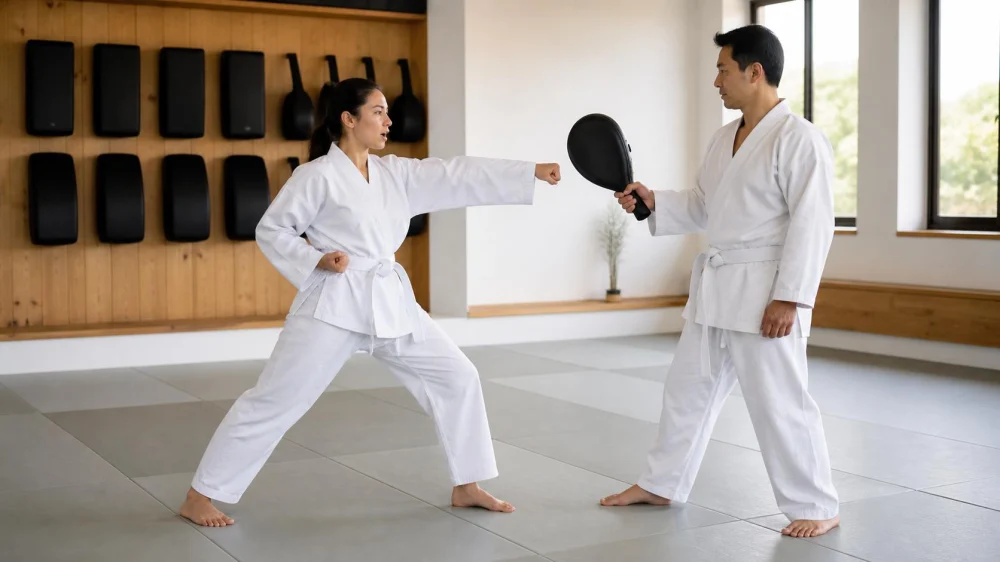
Next, use a pad drill with an instructor holding the target. Agree on one technique, light contact, and one vocal cue. The holder should not interpret volume as permission to increase power.
For poomsae, mark the assigned kihap points in your sequence notes and practice the surrounding movements smoothly. For sparring, follow the rules and coaching; do not use continuous yelling to distract from control, distance, defense, or referee commands.
Correct common errors
- Long shout: shorten it so the sound does not delay the next breath.
- Throat squeeze: reduce volume, reset posture, and practice an easy exhale first.
- Raised shoulders: lower effort and keep the upper body free enough to move.
- Late timing: slow the technique and place the cue at one defined instant.
- Sound on every movement: follow the drill's selected moments rather than adding noise automatically.
- Volume competition: judge control and coordination, not who is loudest.
Limitations and safety notes
- Stop forcing the sound if you develop throat pain, persistent coughing, voice loss, dizziness, or unusual breathing difficulty.
- People with a voice, respiratory, cardiac, pelvic-floor, or post-surgical concern should follow guidance from an appropriately qualified healthcare professional.
- Do not hold the breath through repeated high-effort techniques unless a qualified professional has specifically directed a clinical exercise.
- Use hearing protection policies and reasonable volume in small or acoustically harsh rooms.
- This article provides general training guidance; the instructor defines the class method and event rules.
Frequently asked questions
What word should I shout for a kihap?
Use the short sound your school teaches. The exact syllable varies and matters less than clear timing, controlled exhalation, and safe vocal effort.
Should a kihap be as loud as possible?
No. It should be audible enough for its training purpose without throat strain, breath disruption, or loss of control. More volume is not automatically better technique.
When do I kihap in a poomsae?
Use the points specified for that poomsae by your school or governing rules. Do not guess from another version, because sequences and conventions can differ.
Can I practice quietly at home?
Yes. Practice timing with a short exhale or low-volume sound while preserving normal breathing. Confirm the full class sound with your instructor.
Why do I feel dizzy after shouting?
Stop and sit or stand safely. Forced exhalation, breath holding, rapid repeated breathing, heat, or another issue may contribute. Seek medical advice if dizziness is severe, recurrent, or accompanied by urgent symptoms.
Conclusion and next steps
Ask your instructor to identify one technique and one exact kihap moment. Practice it slowly with an easy exhale, then add speed only while posture, sound, and recovery breathing remain controlled. Let timing and focus improve before volume.
Evidence note: These recommendations reflect common martial-arts coaching, breathing, and voice-care principles. Exact kihap conventions come from the school and event rules; health restrictions require individualized professional guidance.


 Aikido of San Jose4.0 (7 reviews)
 Nikko Jujitsu School4.0 (9 reviews)
 Gracie Barra San Clemente Martial Arts4.0 (47 reviews)
 Karate Institute of America4.0 (4 reviews)
 Keweenaw Korean Martial Arts0.0 (0 reviews)
 Wing Chun School of Internal Arts5.0 (6 reviews)
 How to Execute a Jumping Roundhouse Kick to the Head
 How to Execute a Double Kick Combination in Sparring
 How to Perform a Flawless Axe Kick: A Step-by-Step Guide
 DIY Tae Kwon Do Training Equipment for Home Practice
 How to Increase Your Vertical Jump for Tae Kwon Do Flying Kicks
 The History of the Tae Kwon Do Peace Corps