
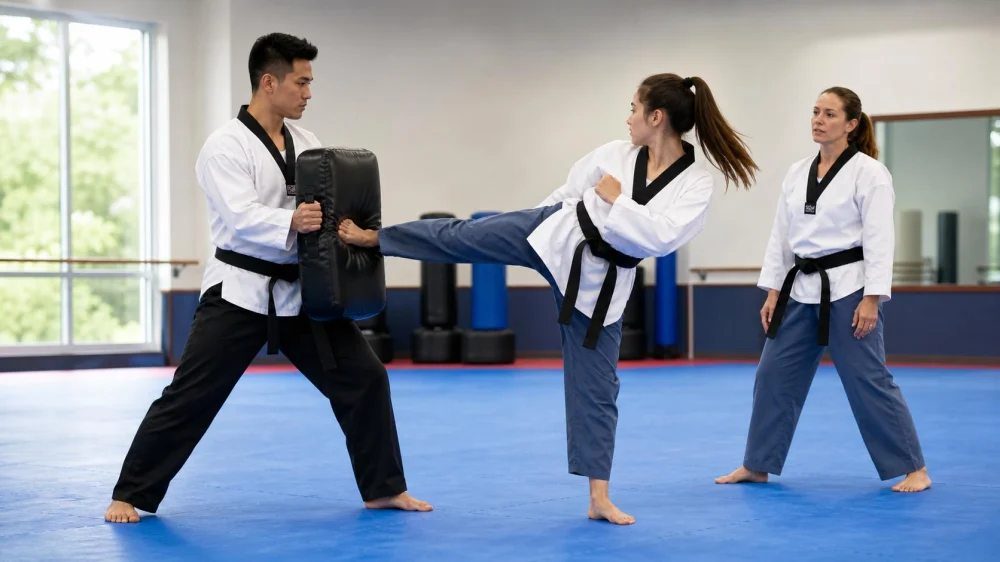
Tae Kwon Do Kick Pad Holding: Set Angle, Distance, and Exit
On this page
Quick answer
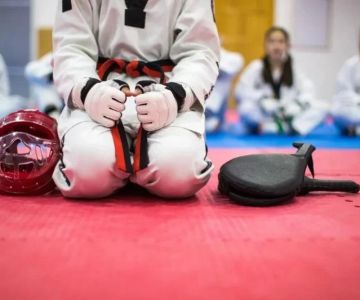
Before holding a kick pad, agree on the technique, target height, power, number of repetitions, and stop cue. Use the instructor's approved grip and stance, keep fingers and head outside the strike path, brace without locking joints, and leave room for the kicker to chamber, pivot, extend, recoil, and land. Start slowly. Stop when either partner loses balance, alignment, attention, or equipment control.
Budo Martial Arts Studio / budo martial arts studio
Ewing TownshipMercer CountyNew Jersey
9 Scotch Rd, Ewing Township, NJ 08628, USA
Why it matters
Pad holding is an active partner skill. Poor distance or angle can redirect force into wrists, shoulders, head, knees, or the kicker's foot and can teach inaccurate range.
This United States guide is general. School curriculum, age, rank, pad design, technique, contact level, disability, and instructor methods differ. Follow the instructor and equipment maker.

Champions Martial Arts Plainview / champions martial arts plainview
PlainviewNassau CountyNew York
10 Washington Ave, Plainview, NY 11803, USA
Practical checklist
- Inspect handles, seams, padding, straps, and dry grip surfaces.
- Name the kick and identify the intended contact surface.
- Agree on height, angle, distance, power, repetitions, and stop word.
- Clear people, walls, bags, and loose gear from the movement lane.
- Set holder stance and hand position under instructor supervision.
- Begin with one slow technical repetition.
- Reset fully after every strike rather than chasing the pad.
Step-by-step plan
- Watch the instructor demonstrate the exact hold and common impact direction.
- Place the target where the kicker can reach without leaning, jumping unexpectedly, or overextending.
- Keep the pad between impact and torso while keeping the face and fingers out of line.
- Use a stable staggered or instructed stance and absorb force through the whole body without snapping joints.
- Give one clear cue, then stay predictable through chamber and recoil.
- Lower power immediately if the pad twists, the holder steps uncontrollably, or contact misses the intended surface.
- Switch roles with enough rest and report pain or equipment damage.
Track pad type, technique, side, height, power, repetitions, instructor cues, misses, pain, balance changes, and equipment faults.
Limits and warning signs
A bigger pad does not make an unsafe angle safe. Holders should not surprise the kicker by moving the target, adding combinations, or demanding power beyond rank and control.
Stop for head impact, severe pain, deformity, numbness, inability to bear weight, loss of consciousness, or concussion signs. Follow the school's emergency plan and seek medical care as appropriate.
Frequently asked questions
Should the holder push into the kick?
Only use the instructor's method. Excessive counterforce can injure both partners and distort technique.
How high should the pad be?
Match the assigned technique and the kicker's controlled range, not an arbitrary height.
Can beginners hold power kicks?
Use instructor-assigned pads, power, and supervision; technical control comes first.
What if the pad keeps twisting?
Stop and check grip, angle, distance, equipment size, and power with the instructor.
Sources and evidence
The guide reflects common partner-training safety: inspect equipment, define the drill, clear space, align the target with expected force, start slowly, use predictable cues, and stop when control deteriorates.
Conclusion and next steps
Ask the instructor to confirm the grip, stance, and pad angle before the first kick. Run one slow repetition, reset completely, and increase speed or power only while both partners remain stable.


 Aikido of San Jose4.0 (7 reviews)
 Nikko Jujitsu School4.0 (9 reviews)
 Gracie Barra San Clemente Martial Arts4.0 (47 reviews)
 Karate Institute of America4.0 (4 reviews)
 Keweenaw Korean Martial Arts0.0 (0 reviews)
 Wing Chun School of Internal Arts5.0 (6 reviews)
 How to Execute a Jumping Roundhouse Kick to the Head
 How to Execute a Double Kick Combination in Sparring
 How to Perform a Flawless Axe Kick: A Step-by-Step Guide
 DIY Tae Kwon Do Training Equipment for Home Practice
 How to Increase Your Vertical Jump for Tae Kwon Do Flying Kicks
 The History of the Tae Kwon Do Peace Corps