
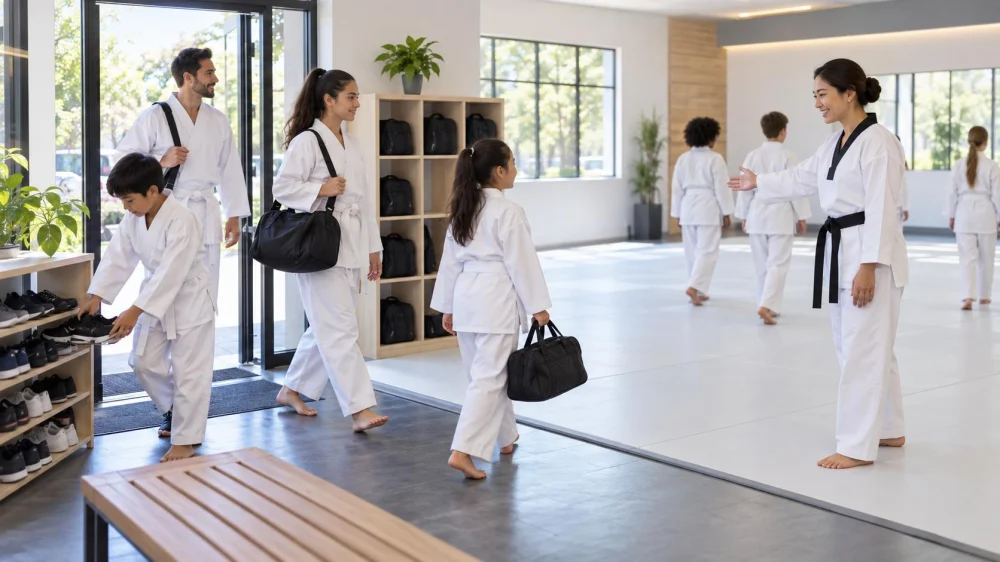
Tae Kwon Do Dojang Entry: Shoes, Bags, and Floor Care
On this page
- Quick answer
- Learn the local routine
- Arrive with transition time
- Manage outdoor shoes
- Protect feet and the training floor
- Put bags where they cannot create hazards
- Check personal gear before entering
- Use respectful, local etiquette
- Keep spectator and pickup areas orderly
- Limits and important notes
- Frequently asked questions
- Sources and evidence notes
- Conclusion and next steps
Quick answer
Arrive early enough to follow the Tae Kwon Do school's entry routine without rushing. Check in, remove outdoor shoes where directed, place bags and coats in the assigned area, and keep aisles and exits clear. Wash or clean feet according to school policy, cover cuts appropriately, and bring only approved gear onto the floor. Silence devices, greet instructors and classmates using local customs, wait for permission if class has started, and report spills or floor damage before training.
Budo Martial Arts Studio / budo martial arts studio
Ewing TownshipMercer CountyNew Jersey
9 Scotch Rd, Ewing Township, NJ 08628, USA
Learn the local routine
Dojang layouts and customs differ. Some schools bow at a doorway or flag, line up by rank, require check-in, or use separate routes for spectators and students. Observe and ask rather than copying a ritual without context.
Parents and visitors should also learn where to wait, whether photography is permitted, and which floor areas are restricted.
Champions Martial Arts Plainview / champions martial arts plainview
PlainviewNassau CountyNew York
10 Washington Ave, Plainview, NY 11803, USA
Arrive with transition time
Allow time for parking, check-in, changing, toilets, gear inspection, and a calm mental shift into class. Running in late can lead to missed safety information and a rushed warm-up.
If late, stay at the edge and make eye contact with the instructor. Enter only when directed and join at the appropriate intensity.
Manage outdoor shoes
- Remove shoes at the marked boundary.
- Place them on the rack or in a bag, not in the walkway.
- Wear approved indoor footwear only when policy or access needs allow.
- Do not step off the floor in bare feet and return without cleaning.
- Keep wet or muddy shoes isolated from uniforms and pads.
- Ask about footwear for injuries, orthotics, or medical needs before class.
Protect feet and the training floor
Arrive with clean, dry feet and trimmed nails. Cover cuts or skin conditions according to appropriate guidance and tell the instructor about concerns that affect safe participation. Do not apply slippery lotion immediately before training.
Report liquid, grit, torn mats, raised seams, sharp objects, or unusual residue. Keep others away until staff addresses it; do not improvise with an unknown cleaner.
Put bags where they cannot create hazards
Zip bags and place them in cubbies, lockers, or the assigned wall area. Keep straps, bottles, phones, jewellery cases, and sparring gear out of aisles, doorways, and mat edges.
Bring only the equipment needed for the session. Label items discreetly and secure valuables according to school policy rather than leaving them inside an open bag.
Check personal gear before entering
- Confirm the uniform is clean, dry, and safely hemmed.
- Remove jewelry and hard accessories as required.
- Inspect pads and protective gear for damage and odour.
- Close hook-and-loop fasteners so they do not scratch others.
- Fill and seal the water bottle.
- Keep medicines or medical devices accessible according to the plan.
Use respectful, local etiquette
Follow the school's greeting, bowing, title, and lineup practices. The purpose is attention and respect, not performing a universal script. Ask quietly if a custom is unfamiliar or conflicts with a personal need.
Keep conversation low while another group finishes. Do not cross between an instructor and class or handle another student's belt or equipment without permission.
Keep spectator and pickup areas orderly
Children, siblings, caregivers, and visitors should remain in the designated area without blocking exits or distracting students. Follow food, drink, photography, device, and supervision rules.
At pickup, wait until the instructor releases the student and collect bags and shoes away from the next class's entry path.
Limits and important notes
Entry etiquette and hygiene rules vary by school, culture, building, activity, age group, and accessibility need. Respectful participation can include reasonable alternatives arranged in advance.
This is general class-preparation guidance, not medical, disability, cultural, or legal advice. The instructor, school policy, facility rules, event organizer, and appropriate professional govern specific needs.
Frequently asked questions
Can I wear socks on the mat?
Only if the school allows them and they provide appropriate grip. Ask about approved footwear or access accommodations.
What if I arrive after class starts?
Wait at the edge, get the instructor's attention, and enter when directed rather than joining immediately.
Where should a water bottle go?
Use the designated location off the active floor where it will not spill or block movement.
Sources and evidence notes
This article applies general martial-arts etiquette, facility hygiene, trip-prevention, gear organization, supervision, and respectful-participation principles. The school's current policy, instructor directions, facility rules, and individual access or health plan control a specific class.
Conclusion and next steps
Ask the school for its entry, footwear, bag, and visitor rules before the next session. Arrive early, clear the floor boundary deliberately, and report hazards. A consistent two-minute entry routine protects the space and helps class begin with attention instead of clutter.
 Aikido of San Jose4.0 (7 reviews)
 Nikko Jujitsu School4.0 (9 reviews)
 Gracie Barra San Clemente Martial Arts4.0 (47 reviews)
 Karate Institute of America4.0 (4 reviews)
 Keweenaw Korean Martial Arts0.0 (0 reviews)
 Wing Chun School of Internal Arts5.0 (6 reviews)
 How to Execute a Jumping Roundhouse Kick to the Head
 How to Execute a Double Kick Combination in Sparring
 How to Perform a Flawless Axe Kick: A Step-by-Step Guide
 DIY Tae Kwon Do Training Equipment for Home Practice
 How to Increase Your Vertical Jump for Tae Kwon Do Flying Kicks
 The History of the Tae Kwon Do Peace Corps