
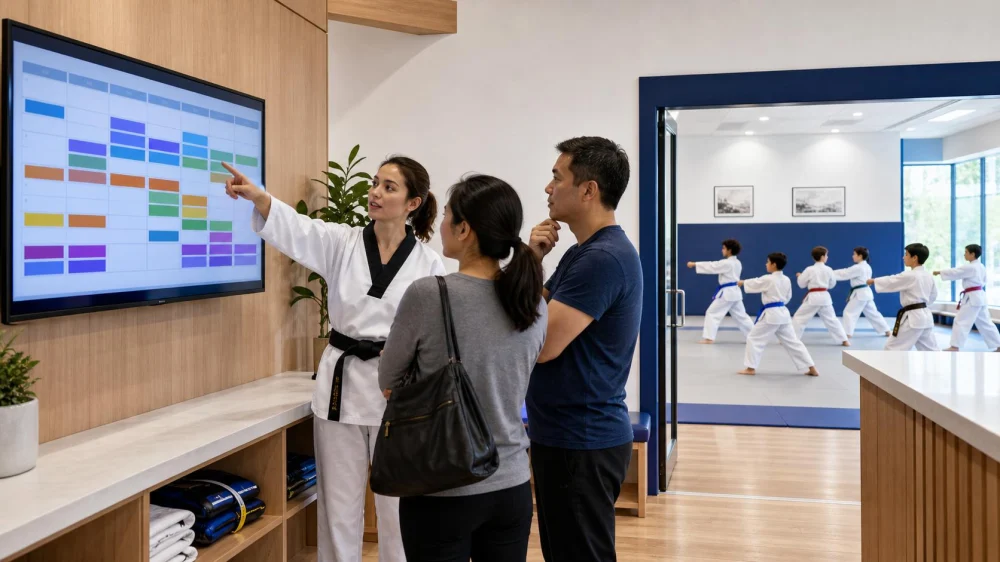
Tae Kwon Do Class Schedule: Choose the Right Session
Table of contents
Quick answer
Before booking a Tae Kwon Do class, confirm the age group, rank range, curriculum focus, contact level, prerequisites, required gear, instructor, duration, and arrival time. Labels such as basics, all ranks, open mat, poomsae, sparring, competition team, and family class do not mean the same thing at every school. Send the dojang your experience, goals, health or accessibility needs, and current affiliation, then ask which exact session is appropriate.

Wolf MMA / wolf hills jiu jitsu
Falls ChurchFairfax CountyVirginia
7799 Leesburg Pike suite 110, Falls Church, VA 22043, USA
Decode the class labels
“Beginner” may mean first-day students, white and yellow belts, or anyone new to that school’s curriculum. “All ranks” can combine students while dividing drills by level. “Open mat” may be supervised practice rather than formal instruction. Leadership, demonstration, competition, black-belt, weapons, breaking, conditioning, and instructor-development sessions often have separate permission or equipment requirements. Ask for a plain-language description of what happens during the class.

Franklin Family Taekwondo / franklin family taekwondo
FranklinWilliamson CountyTennessee
454 Downs Blvd #140, Franklin, TN 37064, USA
Check age, rank, and prerequisites
Age bands reflect attention span, class pacing, partner size, safeguarding, and curriculum design, but cutoffs vary. Rank color also differs across organizations, so state your training time, school, and tested rank rather than assuming equivalence. Visiting black belts and transfer students may need instructor review before joining advanced material. Competition teams may require regular attendance, coach invitation, rule knowledge, or tournament registration.
Compare forms, sparring, and basics
A basics class often emphasizes stance, footwork, blocks, kicks, and repetition. Poomsae or forms sessions focus on sequence, rhythm, direction, and performance standards. Sparring can range from no-contact drills to controlled partner work or competition preparation, with different protective gear and rule sets. Conditioning may involve general fitness rather than technical instruction. Ask how much contact, partner work, jumping, and floor work to expect.
Confirm equipment and logistics
- Ask whether a uniform is required or athletic clothing is acceptable for a first visit.
- Confirm shoes, bare feet, socks, jewelry, hair, nails, and hygiene policies.
- List required sparring gear and whether loan equipment is available.
- Check arrival time, changing rooms, parking, pickup, and spectator rules.
- Verify class length, breaks, water access, late-entry policy, and cancellation terms.
- Ask whether registration, waiver, membership, or insurance information is needed first.
Health and accessibility questions
Tell the school privately about relevant injuries, disability access, sensory needs, pregnancy, recent illness, medication effects, or clinician restrictions. Ask whether drills can be modified and who makes that decision. A class title cannot provide medical clearance. Stop activity for pain, dizziness, chest symptoms, confusion, or unusual breathing difficulty and seek appropriate help. Parents should confirm supervision, safeguarding, pickup authorization, and emergency contact procedures.
Booking checklist
Record school name, class title, date and time, age range, accepted ranks, instructor, focus, contact level, partner work, prerequisites, equipment, uniform, arrival time, duration, fees, cancellation policy, accessibility, parent or spectator rules, and emergency procedures. Send a short message with experience and goals, save the reply, and recheck the live schedule before travel because substitutes, holidays, testing, and events can change normal classes.
Limits and school differences
This general U.S. guidance cannot determine whether a session is safe or suitable for a specific student. Terminology, belt systems, curriculum, contact rules, instructor credentials, waivers, and youth policies vary by dojang and organization. Do not enter advanced, sparring, breaking, or competition training without permission and proper preparation. Follow the current school schedule, instructor direction, governing rules, healthcare guidance, and parent or guardian decisions.
Evidence notes
The strongest scheduling evidence is the school’s current written description plus direct confirmation from authorized staff. A useful match connects student age, experience, rank equivalence, goals, contact comfort, equipment, accessibility, and prerequisites to the actual lesson plan. Screenshots of an old schedule or third-party directory may be outdated; a dated confirmation reduces misunderstandings and gives staff a chance to recommend a safer alternative.
Frequently asked questions
Does “all ranks” include first-time students?
Sometimes, but not always. Ask whether newcomers receive orientation and level-specific instruction.
Can I join sparring without gear?
Do not assume so. Confirm required protective equipment, fit checks, loan policies, and instructor permission.
Will my belt transfer to another school?
Recognition varies. Provide your training history and let the receiving instructor assess placement.
Is open mat the same as a class?
Not necessarily. It may offer practice space with limited instruction and separate eligibility rules.
Can parents watch every class?
Spectator policies vary by space, safeguarding, and teaching approach. Confirm before arriving.
Next steps
Choose two possible sessions, send the school your age group, experience, rank, goals, contact preferences, equipment, and access needs, then ask which class staff recommends. Confirm arrival time, waiver, uniform, fees, and live schedule. Attend only the approved session, introduce yourself to the instructor, and request modifications before drills begin.





 Taekwon-Do Mixed Martial Arts Fitness Academy5.0 (10 reviews)
 Balmer Martial Arts5.0 (10 reviews)
 Giordano's ATA Martial Arts SCV5.0 (5 reviews)
 Z-Ultimate Self Defense Studios5.0 (8 reviews)
 Kisu's Karate LLC5.0 (14 reviews)
 Traditional Okinawan Karate5.0 (45 reviews)
 How to Execute a Jumping Roundhouse Kick to the Head
 How to Execute a Double Kick Combination in Sparring
 How to Perform a Flawless Axe Kick: A Step-by-Step Guide
 DIY Tae Kwon Do Training Equipment for Home Practice
 How to Increase Your Vertical Jump for Tae Kwon Do Flying Kicks
 The History of the Tae Kwon Do Peace Corps