
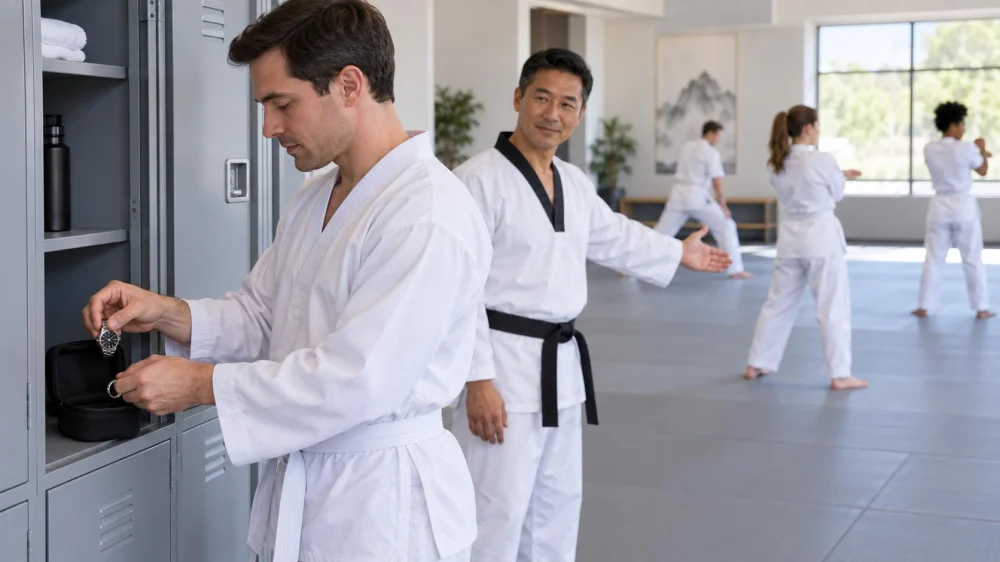
Tae Kwon Do Class Jewelry: Remove, Store, and Return
On this page
- Quick answer
- Understand why jewelry changes risk
- Check the policy before arrival
- Remove valuables at home when practical
- Use a stable removal area
- Plan for new or difficult piercings
- Store items securely
- Check items after class
- Limits and important notes
- Frequently asked questions
- Sources and evidence notes
- Conclusion and next steps
Quick answer
Before Tae Kwon Do class, ask the school which jewelry, watches, piercings, hair accessories, glasses, and medical items must be removed or protected. Remove permitted items before warm-up, not beside an active mat. Place them in a named case within a locked or supervised location rather than a loose pocket. Never tape over jewelry unless the instructor and appropriate professional approve that plan. After class, check the case and locker area before leaving and report a missing item promptly.

Budo Martial Arts Studio / budo martial arts studio
Ewing TownshipMercer CountyNew Jersey
9 Scotch Rd, Ewing Township, NJ 08628, USA
Understand why jewelry changes risk
Rings, bracelets, necklaces, earrings, watches, hard hair accessories, and exposed piercings can catch on uniforms, pads, partners, or equipment. They may scratch another person, press into the wearer, break, or fall onto the training floor.
Rules depend on class format and school policy. Non-contact basics and partner sparring may use different restrictions, but the instructor's decision applies before participation.
Champions Martial Arts Plainview / champions martial arts plainview
PlainviewNassau CountyNew York
10 Washington Ave, Plainview, NY 11803, USA
Check the policy before arrival
- Ask what must be removed for warm-up, forms, pad work, and sparring.
- Confirm rules for new or non-removable piercings.
- Ask about prescription glasses, hearing devices, medical alerts, and religious items.
- Learn whether lockers are provided and whether a personal lock is allowed.
- Check tournament rules separately from regular class.
- Tell the instructor privately about an item requiring accommodation.
Remove valuables at home when practical
The simplest routine is often to leave nonessential jewelry and watches at home. This prevents last-minute removal, forgotten lockers, and small objects falling into a gym bag.
Do not remove necessary medical identification or assistive devices without an appropriate plan. Ask the school and healthcare professional how safety and access can be balanced.
Use a stable removal area
Step away from the mat and moving students. Use clean dry hands, a tray or cloth, and a well-lit surface so small fasteners do not roll away. Do not remove jewelry while walking or holding other equipment.
Count items into a dedicated case. Photograph valuable pieces before leaving home if identification would help, but avoid displaying them publicly.
Plan for new or difficult piercings
A fresh piercing may not be safe to remove, while leaving it exposed may conflict with class rules. Contact the instructor before attending and seek advice from a qualified piercer or healthcare professional about healing and removal.
Tape is not a universal solution: it can loosen, hide a snag point, irritate skin, and still leave hard material beneath. Do not improvise during class.
Store items securely
- Use a small closed case rather than a tissue or open pocket.
- Put the case inside a locked locker or supervised secure area.
- Keep the key or code where it cannot fall during training.
- Do not leave valuables on benches, shoes, or water bottles.
- Avoid sharing locker codes.
- Follow the school's lost-property and liability policy.
Check items after class
Retrieve the case after leaving the active floor and drying hands. Compare the item count, check clasps and watch pins, and put pieces on while seated or stable.
Look around the locker and bag compartments before departing. If something is missing, notify staff promptly with a factual description and last known location rather than searching through another person's belongings.
Limits and important notes
Jewelry rules cannot eliminate every training risk and vary across schools, insurers, tournaments, age groups, and activities. An accommodation may require changing the drill rather than covering an item.
This is general class-preparation guidance, not medical, piercing, religious, disability, insurance, or legal advice. Follow the school, event organizer, healthcare professional, and qualified piercer for specific decisions.
Frequently asked questions
Can I tape over earrings?
Only if the instructor and relevant professional approve it; many schools still require removal because tape does not remove the hard snag point.
What about a wedding ring?
School rules usually apply regardless of meaning. Store it securely or leave it at home.
Can I wear a fitness watch?
Ask first. Watches can strike, catch, or interfere with pads and partners even in a fitness-focused class.
Sources and evidence notes
This article applies general martial-arts class safety, snag prevention, piercing care, valuables storage, and lost-property principles. The school's policy, instructor, event rules, healthcare guidance, qualified piercer, and individual needs determine the correct plan.
Conclusion and next steps
Ask about jewelry and device rules before the next class, then pack a small secure case or leave valuables at home. Remove items away from the mat before warm-up and count them back after class. Resolve new piercings and necessary devices before training begins.


 Aikido of San Jose4.0 (7 reviews)
 Nikko Jujitsu School4.0 (9 reviews)
 Gracie Barra San Clemente Martial Arts4.0 (47 reviews)
 Karate Institute of America4.0 (4 reviews)
 Keweenaw Korean Martial Arts0.0 (0 reviews)
 Wing Chun School of Internal Arts5.0 (6 reviews)
 How to Execute a Jumping Roundhouse Kick to the Head
 How to Execute a Double Kick Combination in Sparring
 How to Perform a Flawless Axe Kick: A Step-by-Step Guide
 DIY Tae Kwon Do Training Equipment for Home Practice
 How to Increase Your Vertical Jump for Tae Kwon Do Flying Kicks
 The History of the Tae Kwon Do Peace Corps