
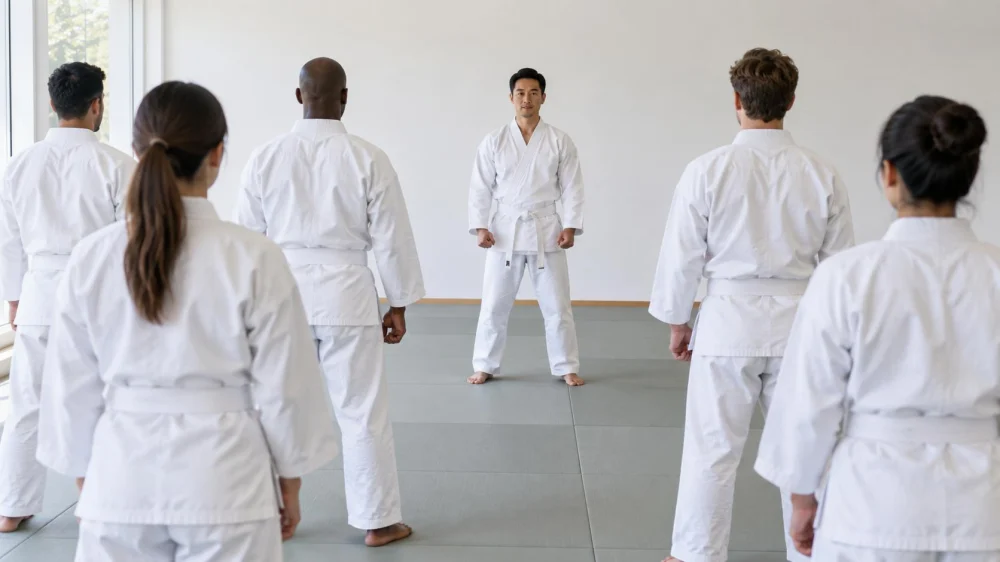
Tae Kwon Do Class Commands: Listen, Confirm, and Move
On this page
Quick answer
Tae Kwon Do schools may use Korean terms, English instructions, counts, hand signals, or a combination. Learn the commands used by your instructor, watch the full demonstration, and confirm the starting direction, target, speed, and stop cue before moving. If you miss a command, pause in a safe position and ask rather than copying late.
Budo Martial Arts Studio / budo martial arts studio
Ewing TownshipMercer CountyNew Jersey
9 Scotch Rd, Ewing Township, NJ 08628, USA
Why class commands vary
A class command is a short verbal or visual cue that organizes attention, stance, movement, repetition, or stopping. The spelling, pronunciation, sequence, and meaning of Korean terms can vary by school, organization, instructor, and English transliteration system.
Some schools teach vocabulary explicitly; others introduce terms through repetition. One instructor may use Korean for counting and English for corrections, while another uses hand signals in a noisy tournament setting. Treat the dojang's current instruction as the operational source rather than assuming a word always triggers the same action everywhere.
Champions Martial Arts Plainview / champions martial arts plainview
PlainviewNassau CountyNew York
10 Washington Ave, Plainview, NY 11803, USA
Prepare before class
- Ask whether the school has a vocabulary sheet, beginner guide, or class video.
- Learn the instructor's attention cue, ready cue, start cue, and stop cue first.
- Tell the instructor privately about hearing, language, processing, vision, or memory needs that affect instructions.
- Choose a place where you can see the instructor without blocking others.
- Agree on how to ask for repetition without interrupting an active drill.
For a child's class, caregivers can ask which few terms are most useful to practice at home. Avoid teaching a different pronunciation or movement sequence unless it matches the instructor's current curriculum.
Use a safe listen-confirm-move routine
- Listen. Stop side conversations and face the instructor when the attention cue is given.
- Watch. Observe the complete demonstration, including starting stance, direction, distance, and finish.
- Confirm. Check the number of repetitions, partner role, contact level, target, and stop signal.
- Move. Begin at the speed instructed and maintain spacing from nearby students.
- Pause. If the cue is unclear or the drill changes unexpectedly, return to the agreed safe position.
Copying the student beside you can help with line orientation, but it should not replace hearing or seeing the actual instruction. That student may be in a different role, correcting an error, or starting on the opposite side.
Build vocabulary without guessing
Create a short personal list using the spelling provided by the school. Pair each term with its class function, not an improvised dictionary definition. For example, note whether the word means attention, ready, begin, stop, turn, or a specific movement in that school's teaching sequence.
Study a few high-frequency cues at a time. Say them only if the instructor asks students to repeat them. Record pronunciation only with permission, and do not record other students without consent. Review after class while the context is fresh.
When two terms sound similar, ask the instructor to demonstrate the difference. A visual comparison can be clearer than a phonetic spelling. Avoid correcting classmates publicly; terminology differences may reflect another recognized teaching tradition.
Ask for accessible communication
Clear instruction benefits everyone. Depending on the student and school, useful supports can include standing closer to demonstrations, facing the class while speaking, pairing words with gestures, providing a written sequence, allowing a moment to process, or checking understanding before contact begins.
Ask early and describe the functional need: “I understand better when I can see the starting position before the count begins.” The instructor can explain what is reasonable for the class format. A student should not be pushed into a drill they do not understand.
Important limits
This guide supports communication and class organization; it does not teach Tae Kwon Do technique or define universal terminology. Follow the qualified instructor, school curriculum, and event rules. Never use an online vocabulary list to override an in-person safety cue.
Stop for pain, dizziness, confusion that affects safe movement, damaged equipment, or lost spacing. Tell the instructor. Medical concerns and return-to-training decisions may require advice from a qualified healthcare professional.
Frequently asked questions
Do I need to memorize Korean before my first class?
Usually not. Ask the school what beginners are expected to know. Focus first on attention, start, stop, and safety cues, then add vocabulary through practice.
Why does another school pronounce a term differently?
Transliteration, regional pronunciation, organization, and teaching tradition can differ. Use the form your instructor teaches while remaining respectful of other systems.
What should I do if I miss the count?
Do not rush to catch up through another person's space. Pause safely, observe, and rejoin when the instructor indicates.
Can I make my own command cards?
Yes, if they reflect the school's terminology and do not contain private class information. Ask the instructor to check them before relying on them.
Sources and evidence notes
This approach reflects broad motor-learning and safety principles: reduce ambiguity, observe the whole task, practice progressively, use consistent cues, and confirm understanding before speed or contact. Specific vocabulary and technique must come from the student's qualified instructor and curriculum.
Next steps
Ask for the school's beginner vocabulary list and identify four priority cues: attention, ready, start, and stop. In class, use the listen-confirm-move routine and pause when uncertain. After class, add only the terms you actually heard and have the instructor verify any confusing pair.

 Aikido of San Jose4.0 (7 reviews)
 Nikko Jujitsu School4.0 (9 reviews)
 Gracie Barra San Clemente Martial Arts4.0 (47 reviews)
 Karate Institute of America4.0 (4 reviews)
 Keweenaw Korean Martial Arts0.0 (0 reviews)
 Wing Chun School of Internal Arts5.0 (6 reviews)
 How to Execute a Jumping Roundhouse Kick to the Head
 How to Execute a Double Kick Combination in Sparring
 How to Perform a Flawless Axe Kick: A Step-by-Step Guide
 DIY Tae Kwon Do Training Equipment for Home Practice
 How to Increase Your Vertical Jump for Tae Kwon Do Flying Kicks
 The History of the Tae Kwon Do Peace Corps