
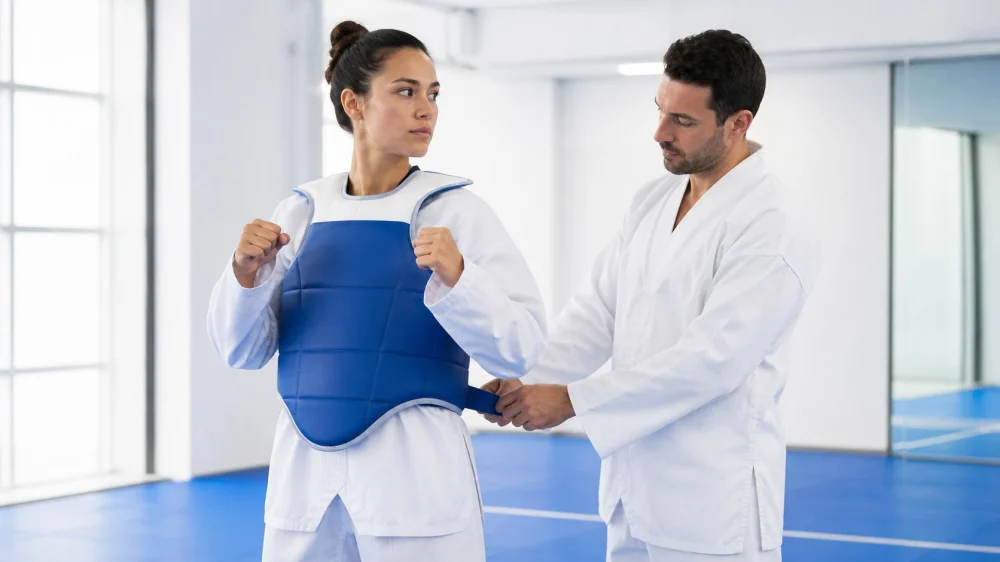
Tae Kwon Do Chest Protector Fit: Check Before Sparring
On this page
- Quick answer
- Confirm school and event requirements
- Choose size before tightening straps
- Check position and movement
- Secure straps without improvising
- Inspect shell, padding, and sensors
- Test the complete protective kit
- Recheck during training
- Chest protector checklist
- Frequently asked questions
- Sources and evidence notes
- Conclusion and next steps
Quick answer
A Tae Kwon Do trunk or chest protector should be the approved type and size for the school or event, cover the intended torso area, stay centered through stance and kicking, and remain secure without restricting normal breathing or shoulder movement. Put it on over the required clothing, fasten it exactly as designed, and test light movement before contact begins.
Stop if the protector rides up, rotates, pinches the neck or arm openings, exposes the target area, has broken padding or straps, or produces unreliable electronic scoring. Do not solve poor fit with knots, tape, added holes, or homemade padding unless the manufacturer and event rules explicitly permit a repair.

Budo Martial Arts Studio / budo martial arts studio
Ewing TownshipMercer CountyNew Jersey
9 Scotch Rd, Ewing Township, NJ 08628, USA
Confirm school and event requirements
Training equipment and competition equipment may differ. Ask the instructor or event organizer for the required brand approval, manual or electronic scoring system, size method, color, uniform placement, inspection time, and whether the organizer supplies the protector.
World Taekwondo competition rules require approved uniform and protective equipment for listed events and describe trunk and head protector-and-scoring systems along with other guards. Local schools, federations, and non-WT events may use different rules. Check the actual event information rather than buying from a generic product title.
Champions Martial Arts Plainview / champions martial arts plainview
PlainviewNassau CountyNew York
10 Washington Ave, Plainview, NY 11803, USA
Choose size before tightening straps
Use the manufacturer’s size chart and have an instructor check coverage. Height or age alone may not predict torso dimensions. A protector that is too large can ride into the neck, interfere with the arms, or rotate; one that is too small may leave intended areas uncovered or place closures under excessive tension.
Try the protector with the dobok and all underlayers that will be worn. Do not use strap tension to force the wrong shell size around the body.
Check position and movement
Center the front panel and align side coverage as the product instructions show. The top edge should not press into the throat, and arm openings should permit guard position and full kicking mechanics without sharp rubbing.
Test fighting stance, guard changes, chambered kicks, pivots, controlled trunk rotation, breathing, and a light kihap. The protector should return to center instead of shifting around the torso. Begin with no-contact movement and have a partner or instructor observe the back and sides.
Secure straps without improvising
Thread, cross, tie, or fasten straps only by the manufacturer’s method. Keep flat straps untwisted and closures fully engaged. Secure loose ends as designed so they cannot strike a partner, catch a hand, or loosen during a round.
Do not add sharp clips, safety pins, metal hardware, adhesive patches, or long dangling ties. Replacement straps should be correct for the model. If the closure cannot remain secure, remove the protector from service.
Inspect shell, padding, and sensors
Before every use, check the outer surface, inner liner, seams, edge binding, padding, straps, buckles, hook-and-loop material, and labels needed for event approval. Look for cracks, hard exposed edges, compressed zones, tears, moisture, odor, contamination, or prior unauthorized repair.
For a protector-and-scoring system, follow the event technician and manufacturer checks. Confirm the correct size, battery or system readiness, sensor pairing, and approved sensing socks where required. Do not hit the protector harder to troubleshoot a scoring problem.
Test the complete protective kit
Fit changes when the dobok, groin guard, forearm guards, shin guards, gloves, sensing socks, mouthguard, and head protection are all present. Dress in the required order and check that components do not overlap incorrectly or restrict each other.
World Taekwondo rules specify a collection of protective equipment before entering the field of play, but school training requirements can differ. A chest protector does not replace other required guards and cannot prevent every injury.
Recheck during training
Pause after warm-up and the first controlled exchange. Sweat and repeated movement can loosen straps or shift the shell. Partners should speak up if an edge becomes exposed or a tie is loose.
Stop immediately for pain, breathing restriction, numbness, skin injury, a damaged protector, or a hard impact followed by concerning symptoms. Equipment adjustment is not a medical assessment.
Chest protector checklist
- Confirm the required approved model and scoring system.
- Use the manufacturer’s size chart.
- Fit it over the actual dobok and underlayers.
- Center the shell and check torso coverage.
- Test breathing, guard, kicks, and rotation.
- Fasten straps only by the designed method.
- Inspect padding, edges, seams, and closures.
- Complete event electronic checks without hard impacts.
- Recheck after warm-up and during breaks.
- Remove damaged or unstable equipment from service.
Frequently asked questions
Should the protector feel tight?
It should remain secure without restricting breathing, movement, or circulation. Use the correct size rather than overtightening.
Can I tie a broken strap with tape?
Do not improvise a sparring repair. Use an approved replacement or another serviceable protector.
Who supplies electronic chest protectors?
It varies. Some WT-promoted events provide trunk PSS equipment; confirm the event instructions.
Can I wear it over a sweatshirt?
Only if the school or event and product instructions allow that layer. Fit it with the actual required uniform.
Why does it rotate when I kick?
The size, position, strap routing, or closure tension may be wrong. Stop and have an instructor refit it.
Does a chest protector prevent all rib injuries?
No. It reduces or manages certain impacts but does not eliminate injury risk or replace controlled contact.
Sources and evidence notes
The World Taekwondo Competition Rules and Interpretation describes approved competition uniforms, trunk and head protector-and-scoring systems, and other protective equipment for WT events.
Fit details come from the protector manufacturer, school, and event. Always use the current event edition and official equipment list; this guide does not replace inspection by an instructor or technical official.
Conclusion and next steps
Confirm the required protector, select the correct shell size, center it over the actual uniform, and test controlled movement before contact. Inspect every surface and closure and remove unstable equipment from service. Recheck after warm-up, and let instructors or event technicians resolve fit and electronic-scoring issues.
 Aikido of San Jose4.0 (7 reviews)
 Nikko Jujitsu School4.0 (9 reviews)
 Gracie Barra San Clemente Martial Arts4.0 (47 reviews)
 Karate Institute of America4.0 (4 reviews)
 Keweenaw Korean Martial Arts0.0 (0 reviews)
 Wing Chun School of Internal Arts5.0 (6 reviews)
 How to Execute a Jumping Roundhouse Kick to the Head
 How to Execute a Double Kick Combination in Sparring
 How to Perform a Flawless Axe Kick: A Step-by-Step Guide
 DIY Tae Kwon Do Training Equipment for Home Practice
 How to Increase Your Vertical Jump for Tae Kwon Do Flying Kicks
 The History of the Tae Kwon Do Peace Corps