
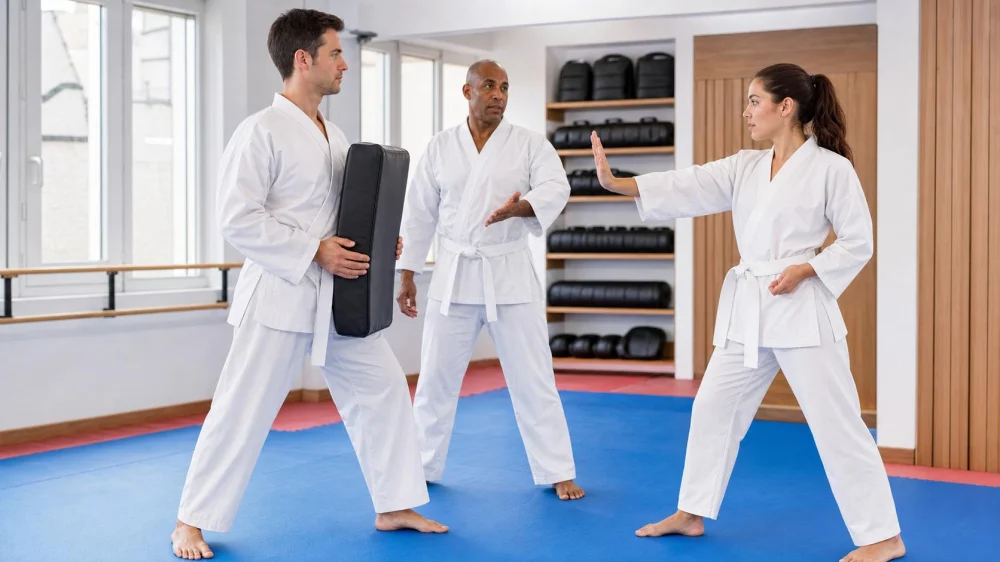
How to Be a Safe Tae Kwon Do Training Partner
On this page
Quick answer
A safe Tae Kwon Do partner confirms the drill, contact level and stop signal before starting; gives a stable, appropriate target; matches speed to the less experienced partner; and stops immediately when control, equipment or communication breaks down. Good partner work is cooperative practice, not a contest. Follow the instructor's drill exactly and speak up early about injury, confusion or unwanted contact.
Champions Martial Arts Plainview / champions martial arts plainview
PlainviewNassau CountyNew York
10 Washington Ave, Plainview, NY 11803, USA
Agree before the drill starts
- Listen to the complete instructor demonstration.
- Repeat the drill goal, allowed target and number of repetitions.
- Confirm whether contact is touch, light, pad-only or another stated level.
- Choose a clear stop word or hand signal used by the class.
- Check protective equipment and remove jewellery as required.
- Identify injuries, side preferences or movement limits without pressuring disclosure of private details.
- Make sure the space behind both partners is clear.
Partner drilling is structured cooperative practice in which each person helps the other rehearse timing, distance, accuracy or control under defined rules. Consent to one drill is not blanket consent to higher speed or contact.

United Martial Arts Centers Warwick / umac warwick ny
43 West St, Warwick, NY 10990, USA
Build speed and contact gradually
- Begin slower than the expected final pace.
- Show the path clearly before adding speed.
- Keep the stated target; do not surprise the partner with a different technique.
- Pause if distance changes or another pair enters the space.
- Give concise feedback between repetitions, not during impact.
- Increase intensity only when both partners and the instructor agree.
- End the repetition under balance rather than falling through the target.
Best partner goal: repeatable technique that both people can learn from. Not acceptable: “testing” toughness, retaliating, hiding fatigue or turning a cooperative drill into unscheduled sparring.
Hold pads with a stable setup
Use only pads assigned for the drill and follow the instructor's hand, wrist and body position. Different targets are designed for different techniques and forces.
- Inspect straps, handles, seams and padding before use.
- Keep fingers and thumbs behind the protected surface as instructed.
- Present the pad at a realistic height that does not force unsafe range.
- Brace with the whole stance rather than locking a joint.
- Do not swing the pad into an incoming kick or punch unless specifically coached.
- Lower the target clearly when the drill stops.
- Sanitize shared equipment according to school procedure.
Improvised pad angles can strain the holder's wrists, shoulders or neck and can redirect the striker into another person. Ask for instructor correction rather than guessing.
Manage size, rank, and experience differences
- The more experienced partner should increase clarity and control, not intensity.
- Adjust target height and distance without mocking flexibility or reach.
- Use the class's matching rules for children and adults.
- Do not assume a higher belt wants harder contact.
- Allow extra reset time for a beginner learning foot position.
- Ask the instructor to rematch pairs when size, injury or comfort makes the drill impractical.
Respectful adaptation helps preserve the same learning objective. It should not require a participant to ignore pain or accept contact they did not agree to.
Know when to stop and reset
Stop immediately for a stop signal, loss of balance, damaged gear, unexpected contact, pain, dizziness, confusion, visual change or a head impact. Notify the instructor and follow the school's injury procedure.
Do not encourage same-day return after a suspected concussion or conceal symptoms to finish class. Emergency symptoms such as loss of consciousness, worsening confusion, seizure, repeated vomiting or severe deterioration require urgent medical response.
Habits of a reliable partner
- Arrive clean, with trimmed nails and maintained equipment.
- Rotate roles promptly and count repetitions honestly.
- Keep coaching limited to what the instructor assigned.
- Accept correction without arguing during the drill.
- Thank the partner and report equipment problems.
- Protect privacy; do not post training footage without consent.
- Help maintain clear aisles and organized targets.
Safety and scope notes
This article provides general martial-arts training etiquette and does not teach a fighting technique or replace instructor supervision. Contact rules vary by age, school, organization and competition format.
Participants with injuries, health conditions or recent concussion should follow qualified healthcare advice. An instructor should modify or stop drills when safe participation cannot be maintained.
Frequently asked questions
Should I correct my partner's technique?
Share only brief feedback the instructor invited. Ask the instructor when correction involves safety or a technical change.
What if my partner hits too hard?
Stop, state the agreed contact level and involve the instructor. You do not need to continue unwanted contact.
How hard should I hold a kick pad?
Use the stance and resistance demonstrated for that target and drill. Do not lock joints or create a collision to prove strength.
Can different belt ranks train together?
Yes, when the drill, supervision and intensity are adjusted so both partners can practice safely and productively.
What if I am uncomfortable saying no?
Use the class stop signal, step out and speak with the instructor or safeguarding contact. A responsible school supports clear boundaries.
Next steps
Before your next partner drill, use a ten-second agreement: goal, target, contact, speed and stop signal. Begin slowly, reset after each repetition and ask the instructor early when pad setup, distance or partner matching is uncertain.
 Sequim Martial Arts4.0 (8 reviews)
 United TaeKwonDo Center5.0 (145 reviews)
 North Jersey Judo5.0 (94 reviews)
 United Self Defense Academy - Mission Viejo Karate4.0 (17 reviews)
 Givans Taekwondo5.0 (15 reviews)
 Kim's Olympic Tae Kwon Do Academy4.0 (13 reviews)
 How to Execute a Jumping Roundhouse Kick to the Head
 How to Execute a Double Kick Combination in Sparring
 How to Perform a Flawless Axe Kick: A Step-by-Step Guide
 DIY Tae Kwon Do Training Equipment for Home Practice
 How to Increase Your Vertical Jump for Tae Kwon Do Flying Kicks
 The History of the Tae Kwon Do Peace Corps