
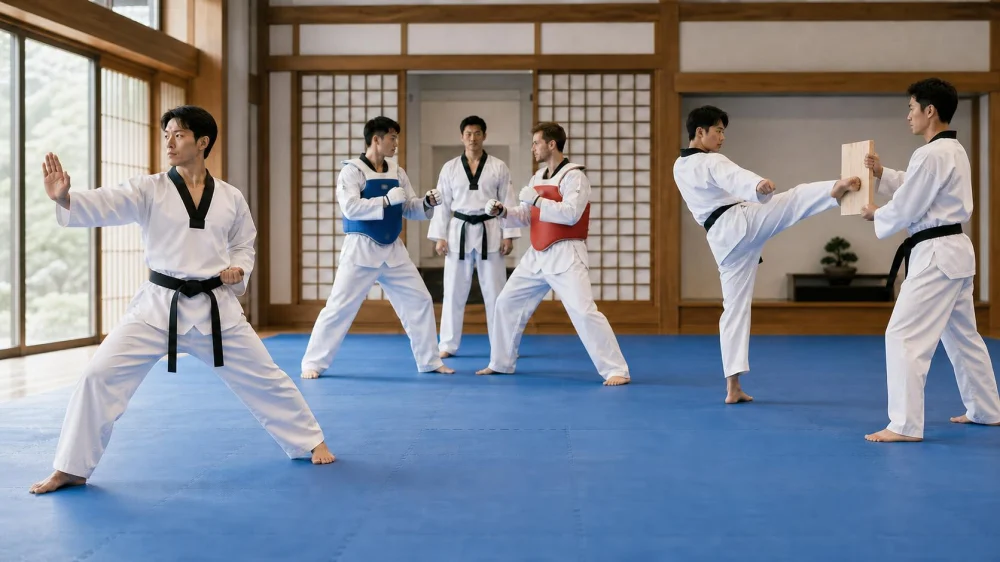
Poomsae, Sparring, and Breaking: Three Ways to Train TKD
On this page
- Quick answer
- Know the three terms
- What poomsae practice emphasizes
- What sparring practice emphasizes
- What breaking practice emphasizes
- Compare the training formats
- How they may appear in class
- A beginner’s participation plan
- Important limits and safety notes
- Frequently asked questions
- Sources and evidence notes
- Conclusion and next steps
Quick answer
Poomsae practices a planned sequence of stances, blocks, strikes, and kicks; sparring applies timing, distance, defense, and decisions with a partner under rules; breaking applies a selected technique to an approved target under close supervision. They overlap, but one is not a substitute for the others. Learn your school’s terminology, curriculum, contact level, equipment, and promotion requirements before comparing progress across formats or attempting unfamiliar drills.
This US beginner guide uses common Kukkiwon and World Taekwondo terminology. Tae Kwon Do organizations, schools, and instructors use different forms, rules, spellings, equipment, and rank requirements. Your instructor’s directions and the specific event rules control.
Budo Martial Arts Studio / budo martial arts studio
Ewing TownshipMercer CountyNew Jersey
9 Scotch Rd, Ewing Township, NJ 08628, USA
Know the three terms
Poomsae means patterns: an organized sequence of techniques performed in an established order and direction. Some schools use “forms” or a different Korean term for their pattern curriculum.
Gyeorugi means sparring. You may also see the spelling kyorugi. It involves interacting with a partner or opponent under defined rules and contact expectations.
Gyeokpa means breaking. It applies a technique to a prepared target such as a rebreakable board or other material selected by the instructor. Demonstration breaking and rank-test breaking can have different purposes and standards.
Champions Martial Arts Plainview / champions martial arts plainview
PlainviewNassau CountyNew York
10 Washington Ave, Plainview, NY 11803, USA
What poomsae practice emphasizes
Poomsae gives students a repeatable framework for stances, transitions, direction changes, balance, breathing, posture, focus, and the sequence of techniques. Because the order is known, the instructor can observe details such as foot placement, chamber, alignment, finish position, and rhythm.
Practice may include:
- learning one section at a time;
- connecting sections without pauses;
- checking stance length and direction;
- matching power and speed to the school’s standard;
- performing alone, in a group, or for evaluation; and
- using video only when the school and people in frame allow it.
Poomsae is best for structured repetition and technical consistency. It is not a live-contact test of how a partner will move, react, or create distance.
What sparring practice emphasizes
Sparring adds an unpredictable partner. Students must recognize distance, timing, openings, boundaries, and changes in pace while following a ruleset. Early drills may be highly controlled: one person attacks with a specified technique while the other moves or defends.
More open sparring can develop:
- distance management and footwork;
- defensive reactions and controlled counters;
- decision-making under time pressure;
- composure and rule awareness;
- communication with a partner and referee; and
- control appropriate to the drill.
Sparring is best for interactive timing and adaptation. It is not permission to use every Tae Kwon Do technique, increase contact without agreement, or ignore age, rank, size, and equipment rules.
What breaking practice emphasizes
Breaking gives a visible target for a specific technique. The setup can emphasize accuracy, correct striking surface, alignment, focus through the target, commitment, and safe follow-through. The instructor determines the target type, thickness, holder position, and whether a technique is appropriate.
Rebreakable boards can support repeated practice, while wood or other materials may be used for tests or demonstrations. Material color or thickness is not standardized across every manufacturer or school. Do not compare two students’ breaking results without knowing the target, support, technique, and rules.
Breaking is best for supervised target application. It is not a home challenge, a measure of fighting ability, or proof that a harder object is appropriate.
Compare the training formats
| Format | Primary training condition | Common feedback |
|---|---|---|
| Poomsae | Planned sequence without an active opponent | Order, stances, direction, technique, rhythm |
| Sparring | Partner movement within rules | Timing, distance, defense, control, decisions |
| Breaking | Technique against an approved target | Accuracy, alignment, striking surface, follow-through |
All three can reinforce balance, coordination, focus, and technical vocabulary, but the context changes what the student must solve. A strong pattern does not automatically produce sparring timing, and sparring success does not automatically produce precise pattern performance.
How they may appear in class
A class might devote separate blocks to basics, poomsae, partner drills, conditioning, and cooldown. Sparring or breaking may occur only on scheduled days, after a student reaches a certain rank, or when required safety equipment and supervision are available.
Promotion tests may evaluate some or all formats along with terminology, courtesy, fitness, self-defense, or other school-specific material. Tournament rules are a separate layer: competition divisions, scoring, uniforms, protective equipment, and permitted techniques may differ from regular class or belt testing.
Ask for the written curriculum or student handbook when available. It is more useful than assuming that a video from another school represents your requirements.
A beginner’s participation plan
- Learn the name of the drill. Confirm whether it is poomsae, one-step practice, pad work, sparring, or breaking.
- Watch one complete example. Notice the start, stop, target, boundary, and instructor signal.
- Ask the contact rule. “No contact,” “light touch,” and competition contact are different conditions.
- Check required gear. Use the school-approved size and type, fitted as instructed.
- Begin at the assigned level. Do not copy an advanced spin, jump, board, or combination.
- Stop on command. Reset distance, equipment, and target before repeating.
- Request one correction. Apply it slowly before adding speed or power.
Important limits and safety notes
Never improvise sparring contact or break household boards, bricks, furniture, concrete, ice, or other objects. Poor target selection, damaged holders, incorrect alignment, and unsupported advanced techniques can cause injury. Only use equipment and materials approved and inspected by the instructor.
Tell the instructor about pain, recent injury, dizziness, illness, or equipment that does not fit. Stop immediately after a hard impact, loss of balance, unusual joint pain, numbness, breathing difficulty, or a head hit, and follow the school’s injury and medical-evaluation procedure. A health professional should guide return to training after injury.
Frequently asked questions
Do all Tae Kwon Do schools teach the same poomsae?
No. Pattern sets and terminology vary by organization and school. Learn the exact name, sequence, and standard your instructor teaches.
Is sparring required for every student?
Requirements vary. Ask the school about rank, age, class type, contact level, protective gear, accommodations, and promotion standards.
Does board color indicate a universal difficulty?
No. Rebreakable-board systems, materials, dimensions, and color scales differ. Use only the target and level assigned by the instructor.
Which format should a beginner practice most?
Follow the school’s curriculum. Beginners often build basics that support all three formats before adding complexity, contact, or harder targets.
Sources and evidence notes
Kukkiwon’s technical terminology resource identifies poomsae as patterns, gyeorugi as sparring, and gyeokpa as breaking. Kukkiwon’s revised textbook overview treats poomsae, sparring, and breaking as distinct major technical areas. World Taekwondo’s rules library maintains separate competition documents for poomsae and kyorugi. School practice remains broader and locally defined.
Conclusion and next steps
Poomsae provides a planned technical sequence, sparring adds a moving partner and rules, and breaking applies a selected technique to a supervised target. Ask your instructor how each format appears in class, what equipment and contact level apply, and how it connects to rank requirements. Treat the three formats as complementary practice contexts, not interchangeable tests or unsupervised challenges.


 Aikido of San Jose4.0 (7 reviews)
 Nikko Jujitsu School4.0 (9 reviews)
 Gracie Barra San Clemente Martial Arts4.0 (47 reviews)
 Karate Institute of America4.0 (4 reviews)
 Keweenaw Korean Martial Arts0.0 (0 reviews)
 Wing Chun School of Internal Arts5.0 (6 reviews)
 How to Execute a Jumping Roundhouse Kick to the Head
 How to Execute a Double Kick Combination in Sparring
 How to Perform a Flawless Axe Kick: A Step-by-Step Guide
 DIY Tae Kwon Do Training Equipment for Home Practice
 How to Increase Your Vertical Jump for Tae Kwon Do Flying Kicks
 The History of the Tae Kwon Do Peace Corps