
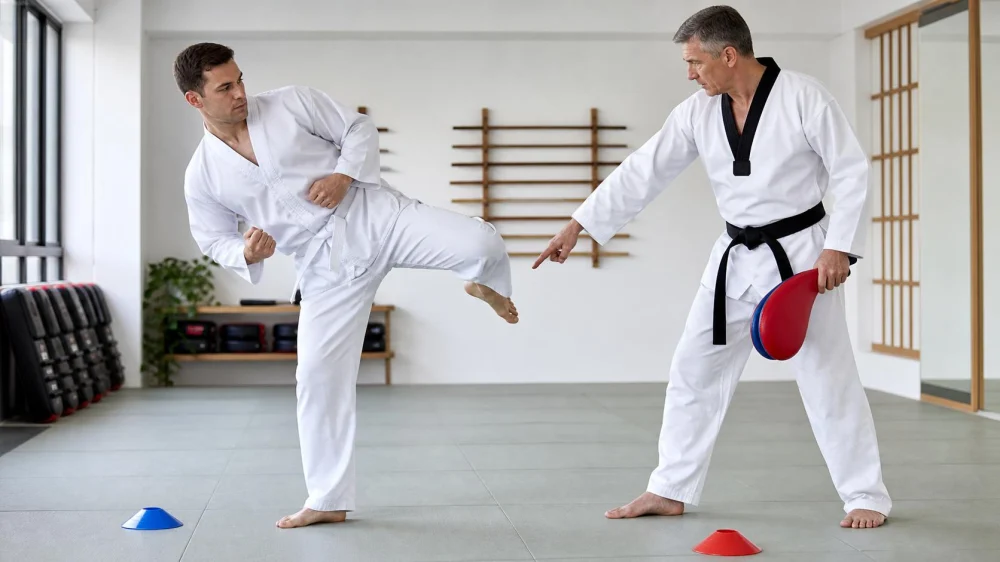
How to Ask for Technique Feedback in Tae Kwon Do Class
On this page
Quick answer
Choose one technique, explain what you are trying to improve, and ask the instructor for one observable correction: stance width, chamber, balance, target, timing, breathing, or return position. Ask before or after class, during an assigned feedback period, or when the instructor is already observing you. Repeat the correction in your own words, practice it slowly, and confirm that you understood before adding speed or power.
Focused feedback is easier to apply than asking, “Was everything okay?”

Giroux Bros Martial Arts / giroux brothers
WilbrahamHampden CountyMassachusetts
2400 Boston Rd, Wilbraham, MA 01095, USA
Choose one technique and one goal
Name the exact skill: a specific kick, block, stance, hand technique, poomsae section, footwork pattern, or partner drill. State the context, such as improving balance in basics or accuracy during controlled pad work.
Do not combine five unrelated questions. If the movement causes pain, instability, dizziness, or unusual symptoms, stop and tell the instructor rather than treating the problem as a normal technique correction.
Plus One Defense Systems / plus one defense
West HartfordCapitol Planning RegionConnecticut
9 Tolles St, West Hartford, CT 06110, USA
Ask at the right time
Avoid interrupting the instructor's explanation, another student's correction, belt testing, active sparring, or safety supervision. Use the school's normal question process. Some instructors prefer questions during practice rounds; others invite them after class.
For a longer review, ask whether a private lesson, video review, or scheduled coaching session is appropriate and whether it has a fee. Respect class turnover and the instructor's next commitment.
Use a specific feedback question
Try: “Which one change would improve my balance in this side kick?” or “Am I returning to a protected stance after this combination?” Show the technique only when invited and at the requested intensity.
Ask what correct performance should feel and look like, what common error to avoid, and which safe drill reinforces the change. Different schools may use different terminology, chamber positions, or poomsae interpretations; follow the curriculum of the instructor teaching the class.
Apply the correction safely
Rehearse at low speed and range first. Change one variable at a time so you can tell whether balance, alignment, accuracy, or control improves. Use pads, partners, and floor space only as directed.
Ask the instructor to watch one more repetition. Do not chase a larger range or higher kick at the expense of posture and control. During partner work, agree on target, contact level, and stop signals before testing a correction.
Track feedback without overthinking
After class, write the date, technique, one correction, one cue, and one practice drill. Avoid turning a short cue into a new self-designed curriculum. Revisit it during assigned practice and ask for follow-up after enough repetitions to observe a pattern.
When feedback from two instructors seems different, describe both versions respectfully and ask which standard applies in the current class, poomsae, or competition context.
Feedback checklist
- Name one technique and context.
- Wait for an appropriate question period.
- Ask for one observable change.
- Demonstrate only when invited.
- Repeat the cue in your own words.
- Practice slowly with one variable changed.
- Confirm contact and partner safety.
- Record the correction and follow up later.
Limitations and safety notes
- Online or written tips cannot replace direct qualified instruction.
- Do not train through sharp pain, head-injury symptoms, faintness, or loss of joint stability.
- Medical rehabilitation and martial arts coaching have different roles.
- Technique standards can vary by organization, school, level, and event.
- Recording people or class material requires permission.
Frequently asked questions
How often should I ask for feedback?
Ask often enough to confirm direction without interrupting practice after every repetition. The instructor can suggest a useful rhythm.
What if I do not understand the correction?
Repeat what you heard and ask for a slower demonstration, different cue, or one comparison between the error and target.
Can I film myself?
Only with school and participant permission. Follow privacy, safeguarding, and facility rules.
Should I ask a higher belt instead?
Follow school culture. Senior students may help when authorized, but the instructor defines curriculum and corrections.
What if feedback feels unsafe?
Stop, explain the concern, and request an alternative. Seek appropriate medical or qualified professional guidance when needed.
Sources and evidence notes
This framework uses effective motor-learning and class-safety principles: focus attention, ask for observable feedback, practice a controlled version, change one variable, confirm understanding, and respect instructor supervision. The school's curriculum and the student's abilities determine the actual technique.
Ask one observable question
Before the next class, choose one technique and complete this sentence: “Could you watch my ___ and tell me the first thing to change for ___?” Write down the answer after class and use only the drill the instructor assigns.

 American Martial Arts4.0 (29 reviews)
 James Taekwondo5.0 (1 reviews)
 East Coast Karate Academy5.0 (25 reviews)
 Highkicks Taekwondo: South Riding4.0 (11 reviews)
 Triumph Taekwondo Bound Brook5.0 (64 reviews)
 T K Gym & Martial Arts5.0 (40 reviews)
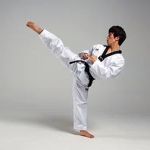 How to Execute a Jumping Roundhouse Kick to the Head
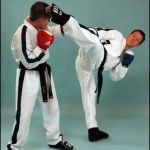 How to Execute a Double Kick Combination in Sparring
 How to Perform a Flawless Axe Kick: A Step-by-Step Guide
 DIY Tae Kwon Do Training Equipment for Home Practice
 How to Increase Your Vertical Jump for Tae Kwon Do Flying Kicks
 The History of the Tae Kwon Do Peace Corps