
Home Tae Kwon Do Poomsae Practice: Map the Space Before You Move
On this page
Quick answer
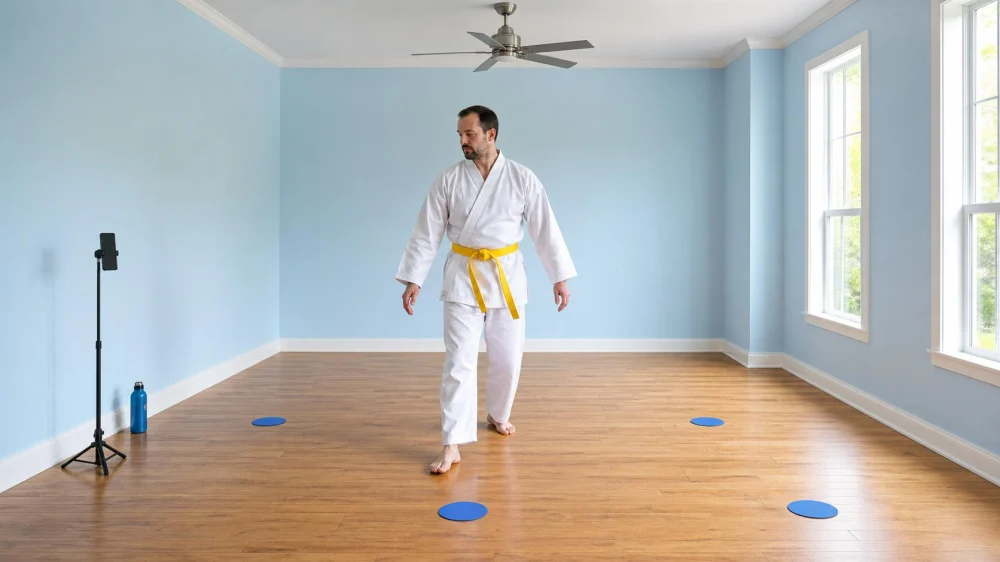
Before practicing Tae Kwon Do poomsae at home, map the entire movement path at walking speed with relaxed hands and low chambers. Clear furniture, pets, people, cords, rugs, fans, lights, windows, and breakable objects beyond arm and kicking reach. Use a dry, level, non-slip surface, keep a stop route, and ask the instructor how to pause or reposition when the room is too small.
A room can look open while still being unsafe for turns, long stances, high blocks, and rearward movement. Clearance includes overhead and diagonal space, not only an empty rectangle on the floor.
Budo Martial Arts Studio / budo martial arts studio
Ewing TownshipMercer CountyNew Jersey
9 Scotch Rd, Ewing Township, NJ 08628, USA
Measure movement, not just floor
Choose the exact form and begin from its normal ready position. Without snapping techniques, walk through every stance and turn. Track the farthest front, back, side, diagonal, arm, and foot reach. Notice where momentum, balance recovery, and a mistaken step could carry you beyond the planned line.
Check ceiling fans, hanging lights, shelves, door handles, countertops, televisions, mirrors, windows, radiators, and low furniture. Allow a buffer around hard and fragile objects. If another person films or observes, their body and tripod also sit outside the movement zone.
Champions Martial Arts Plainview / champions martial arts plainview
PlainviewNassau CountyNew York
10 Washington Ave, Plainview, NY 11803, USA
Clear the training zone
- Tell household members that practice is starting and close or supervise access.
- Move pets to a separate secure area; do not expect them to understand boundaries.
- Remove loose rugs, cords, bags, toys, weights, and floor debris.
- Dry the surface and test traction with normal pivots at low speed.
- Secure doors so they cannot swing into the route, while preserving a safe exit.
- Turn off overhead fans and move breakable or sharp objects beyond the buffer.
- Set the phone, water, and notes outside the path before beginning.
Do not slide heavy furniture alone or train on a surface damaged by moving it. A smaller form segment in a truly clear area is better than a full sequence between obstacles.
Adapt without rewriting the form
Ask the instructor which home-practice adaptation preserves the learning goal. Options may include stopping at a designated point, resetting to the original position, practicing mirrored line segments separately, reducing travel while keeping stance shape, or focusing on hands, breathing, timing, and gaze without full technique speed.
Do not invent extra turns or change the sequence and then memorize the altered version. Record where each pause occurs and mentally reconnect the transition. At the dojang, perform the uninterrupted line under instructor feedback so the home adaptation does not become the tested pattern.
Run a controlled session
Warm up as the school teaches. Perform the first walkthrough slowly, then raise speed only if clearance, traction, direction, and technique remain consistent. Stop when fatigue causes drifting, shortcuts, foot catches, loss of balance, or confusion about direction.
For feedback, record one or two purposeful angles if privacy and school rules permit. Position the device outside reach and never watch the screen while moving. Compare a specific cue—stance length, hand endpoint, turn direction, or finish position—rather than judging the whole form by appearance.
Home-space checklist
- Exact form and movement path walked slowly
- Front, rear, side, diagonal, and overhead reach mapped
- Furniture, cords, rugs, pets, and people removed
- Floor dry, level, and tested for pivots
- Doors controlled and exit kept available
- Instructor-approved pause or reset method chosen
- Camera and water placed outside the path
- Full form rechecked later in proper training space
Limitations
Home surfaces and spaces are not substitutes for a supervised dojang. Apartments, shared homes, outdoor areas, medical conditions, and injuries add noise, impact, weather, privacy, and safety constraints. Do not practice jumping, breaking, weapons, partner contact, or advanced acrobatics without the appropriate supervised environment.
FAQ
Can I practice on carpet?
Carpet type and pivot demands vary. Ask the instructor and test slowly; avoid surfaces that catch the foot or shift.
Should I shorten every stance?
Not automatically. Use an instructor-approved adaptation and practice the full form in adequate space later.
Can a mirror help?
It can provide feedback, but it is also a hard, breakable surface. Stay outside its impact range and do not depend on it while turning.
Is an outdoor patio better?
Only if it is level, dry, clear, private enough, and free of traffic, weather, and overhead hazards.
How much buffer do I need?
Enough for full reach plus balance errors and unexpected movement. Walk the actual form and choose more space when uncertain.
Evidence notes
The school’s poomsae sequence and instructor guidance are the controlling technical sources. A slow movement-path walkthrough, visible clearance, stable traction, and repeatable finish position provide practical evidence that a home setup supports the chosen drill. Competition dimensions do not certify a household room or surface.
Conclusion
Safe home poomsae practice begins before the ready stance. Map every direction, remove people and objects beyond full reach, select an instructor-approved space adaptation, and reconnect the complete form later in the dojang.
 Aikido of San Jose4.0 (7 reviews)
 Nikko Jujitsu School4.0 (9 reviews)
 Gracie Barra San Clemente Martial Arts4.0 (47 reviews)
 Karate Institute of America4.0 (4 reviews)
 Keweenaw Korean Martial Arts0.0 (0 reviews)
 Wing Chun School of Internal Arts5.0 (6 reviews)
 How to Execute a Jumping Roundhouse Kick to the Head
 How to Execute a Double Kick Combination in Sparring
 How to Perform a Flawless Axe Kick: A Step-by-Step Guide
 DIY Tae Kwon Do Training Equipment for Home Practice
 How to Increase Your Vertical Jump for Tae Kwon Do Flying Kicks
 The History of the Tae Kwon Do Peace Corps