
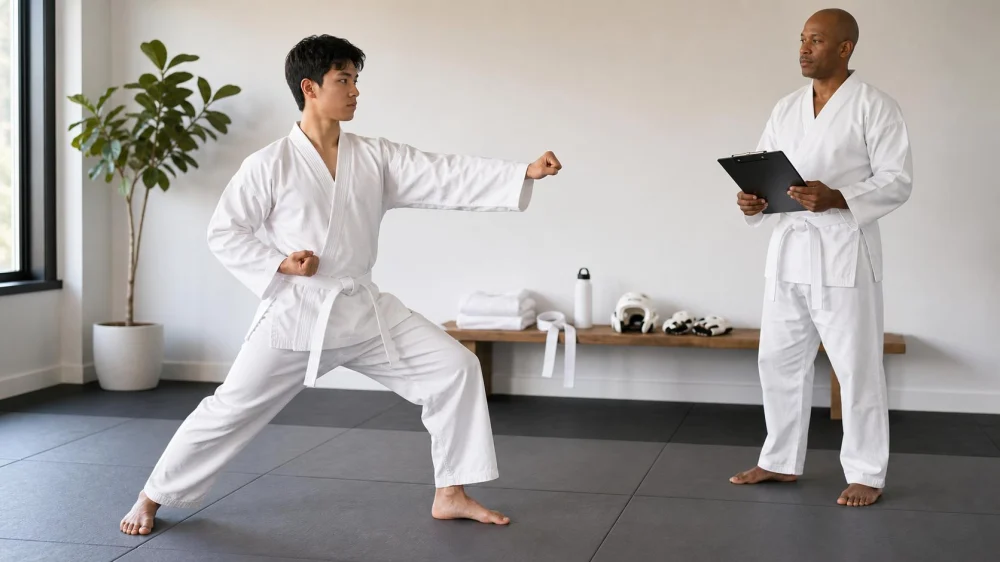
First Tae Kwon Do Belt Test: A Preparation Checklist
On this page
Quick answer
Prepare for a first Tae Kwon Do belt test by getting the exact written syllabus, date, fee, uniform, gear, and etiquette rules from your instructor. Divide requirements into stances, blocks, strikes, kicks, forms, combinations, terminology, fitness, and conduct. Practice short accurate sets, ask for corrections early, rehearse the full sequence weekly, and reduce hard training in the final days so you arrive rested.
Budo Martial Arts Studio / budo martial arts studio
Ewing TownshipMercer CountyNew Jersey
9 Scotch Rd, Ewing Township, NJ 08628, USA
Confirm the requirements
A belt-test syllabus is the dojang’s official list of skills, knowledge, conduct, attendance, and administrative requirements for promotion. It is more reliable than a generic online belt chart.
- Exact techniques, combinations, and form or poomsae.
- Self-defence, sparring, board breaking, or fitness components, if any.
- Korean terms, counting, oath, tenets, or school history.
- Required attendance, instructor approval, forms, fee, and registration deadline.
- Uniform, belt, protective gear, patches, and grooming rules.
- Test date, arrival time, spectators, filming, and estimated duration.
Four-week preparation plan
- Week 1—Map: demonstrate every item slowly, mark what is secure or uncertain, and ask the instructor to correct the largest gaps.
- Week 2—Build: practice difficult pieces in short focused blocks, then connect them into combinations and form sections.
- Week 3—Rehearse: perform the likely order with commands, waiting, transitions, and moderate fatigue.
- Week 4—Polish: keep frequency but reduce extra hard volume, confirm details, and finish gear and logistics.
When less than four weeks remain, use the same order without cramming. Quality corrections and sleep are usually more useful than exhausting last-minute repetitions.
Champions Martial Arts Plainview / champions martial arts plainview
PlainviewNassau CountyNew York
10 Washington Ave, Plainview, NY 11803, USA
Practice for quality
- Start slowly enough to control stance length, balance, chamber, guard, and target.
- Use a mirror or instructor-approved video angle for feedback, not self-ranking.
- Practice both sides when the syllabus requires them.
- Say terms or commands while performing the matching action.
- Separate a form into sections, then reconnect without pauses.
- End each practice with two or three confident complete attempts rather than continuing into poor technique.
Best for improvement is specific feedback: “rear heel lifts during this stance” is more actionable than “make it stronger.”
Conditioning without overtraining
Build test-specific work gradually: short rounds of basics, form repetitions with rest, controlled kicking sets, and the exact fitness task when known. Keep most practice below maximal effort so technique remains clear.
Do not add unfamiliar running, heavy lifting, extreme stretching, or repeated full-power breaking near the test. Persistent pain, swelling, dizziness, concussion symptoms, or illness should be reported to the instructor and evaluated appropriately rather than hidden for promotion.
Etiquette and Korean terminology
- Practice bowing and entering or leaving the training area according to school customs.
- Learn how to address instructors and respond to commands.
- Stand, sit, and wait attentively without distracting other candidates.
- Know when questions are permitted and how to ask respectfully.
- Accept corrections without arguing and continue after a mistake.
Romanization and pronunciation vary among organizations and instructors. Use the version taught by your school.
Uniform and gear checklist
- Clean, dry dobok in the required style.
- Current belt tied as the school teaches.
- Approved mouthguard, protective equipment, and vented cases if sparring is included.
- Water bottle and any permitted personal medication.
- Test form, fee receipt, membership card, or identification when requested.
- Simple hair and nails; remove jewellery according to rules.
- Small repair kit or spare uniform only if the venue allows it.
Test-day plan
- Eat a familiar meal with enough time to digest and hydrate normally.
- Arrive at the stated time—early enough to check in, not so early that you tire.
- Warm up progressively using familiar movements.
- Listen to the complete command before starting.
- If you make a mistake, regain position, follow the examiner’s instruction, and continue.
- Afterward, cool down, thank instructors and partners, and note feedback for the next training cycle.
Limitations and safety notes
Belt colours, minimum time, forms, terminology, breaking, sparring, scoring, and promotion authority vary widely. The instructor’s written syllabus and governing organization control.
A test should not require hiding injury or performing an unsafe skill. Discuss accommodations, age, disability, pregnancy, illness, and medical restrictions early. Seek urgent care for severe injury, chest symptoms, fainting, or concussion warning signs.
Frequently asked questions
What if I forget part of a form?
Pause safely and follow the examiner’s direction. Practise recovery in mock tests; one error does not always determine the result.
How much should I practise daily?
Short focused practice often works better than one long exhausted session. Your instructor can balance frequency with class workload and recovery.
Can parents coach from the audience?
Usually candidates should follow examiners only, but spectator rules vary. Confirm them before the test.
What if I am not ready?
Ask for a pre-test assessment. Delaying can be a sound training decision and gives the instructor time to identify specific goals.
Sources and evidence notes
This guide reflects common martial-arts testing and skill-practice principles. There is no universal Tae Kwon Do belt-test syllabus; school and governing-body requirements are the authoritative source for techniques, terminology, equipment, conduct, and promotion.
Next steps
Obtain the written syllabus today and turn it into a one-page checklist. Ask your instructor to watch one complete run, identify the top three corrections, and confirm test logistics. Schedule focused practice, one weekly rehearsal, and lighter final days.

 Aikido of San Jose4.0 (7 reviews)
 Nikko Jujitsu School4.0 (9 reviews)
 Gracie Barra San Clemente Martial Arts4.0 (47 reviews)
 Karate Institute of America4.0 (4 reviews)
 Keweenaw Korean Martial Arts0.0 (0 reviews)
 Wing Chun School of Internal Arts5.0 (6 reviews)
 How to Execute a Jumping Roundhouse Kick to the Head
 How to Execute a Double Kick Combination in Sparring
 How to Perform a Flawless Axe Kick: A Step-by-Step Guide
 DIY Tae Kwon Do Training Equipment for Home Practice
 How to Increase Your Vertical Jump for Tae Kwon Do Flying Kicks
 The History of the Tae Kwon Do Peace Corps