
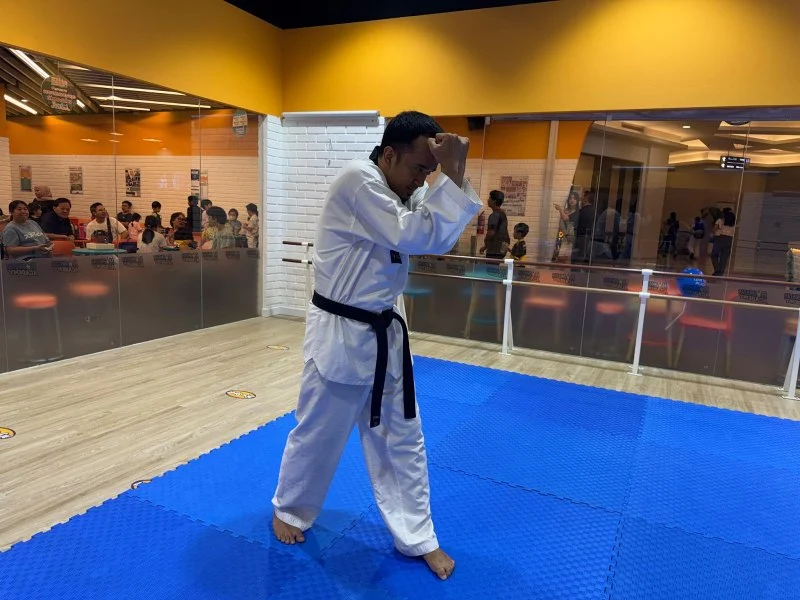
How to Perform a Hooking Block (Golcho Makgi)
In Taekwondo, mastering the fundamentals of both offense and defense is essential for becoming a well-rounded martial artist. One of the critical defensive techniques is the Hooking Block, or Golcho Makgi, a move that can be used to counter attacks and gain control over an opponent's momentum. Whether you're a beginner or an advanced practitioner, understanding how to perform a Golcho Makgi properly is vital for your progression in Taekwondo. This article will break down the key elements of this technique, its proper execution, and tips to refine your skills.
- 1. Understanding the Hooking Block
- 2. Key Steps for Performing the Golcho Makgi
- 3. Common Mistakes and How to Avoid Them
- 4. Drills to Improve Your Hooking Block
- 5. Applying the Hooking Block in Combat
1. Understanding the Hooking Block
The Hooking Block (Golcho Makgi) is a defensive move in Taekwondo that involves a circular motion of the arm to intercept or deflect an incoming attack. It’s typically used against high-line attacks, such as punches or kicks aimed at the head or upper body. This block differs from other standard blocks in that it employs a hooking motion to control and redirect the opponent’s strike, making it a versatile tool in both defense and counterattacks.
Budo Martial Arts Studio / budo martial arts studio
Ewing TownshipMercer CountyNew Jersey
9 Scotch Rd, Ewing Township, NJ 08628, USA
1.1 Purpose of the Hooking Block
The primary purpose of the Golcho Makgi is to redirect an opponent’s strike, especially if their attack is strong or fast. The circular motion of the hook allows you to deflect the incoming attack while simultaneously positioning your body for a counterstrike. This makes the Hooking Block not just a defensive move but an integral part of your Taekwondo offense as well.
Champions Martial Arts Plainview / champions martial arts plainview
PlainviewNassau CountyNew York
10 Washington Ave, Plainview, NY 11803, USA
1.2 Common Uses
Golcho Makgi is commonly used against straight punches, roundhouse kicks, or other attacks coming from the front. It’s a dynamic move, especially effective when you're dealing with powerful strikes, as it allows you to control the trajectory of the opponent's attack and neutralize the threat before they can land a blow.
2. Key Steps for Performing the Golcho Makgi
To execute a proper Golcho Makgi, focus on the following steps to ensure effective technique and power. The movement should be fluid and controlled, as a lack of precision can lead to ineffective blocking.
2.1 Begin with a Proper Stance
Start in a stable fighting stance (such as the front stance, or "Ap Seogi"). Make sure your weight is balanced and you are ready to react quickly to incoming attacks. A strong stance is the foundation for executing any technique effectively, including the Hooking Block.
2.2 The Circular Motion
The essence of the Golcho Makgi is the circular motion of the arm. Begin by raising your blocking arm to shoulder height, with your palm facing inward. As the opponent’s attack approaches, sweep your arm in a hooking motion, directing it outward and around, with the goal of deflecting the incoming strike. The motion should resemble a hook or arc, which is why it’s called the “hooking” block.
2.3 Redirecting the Force
As your arm moves in the circular motion, focus on redirecting the force of the opponent’s attack away from your body. The hook should not only block but also push the strike off to the side, leaving you in a position to counterattack or control the opponent’s next move.
2.4 Completing the Block
At the end of the motion, your arm should be fully extended in front of you, with your palm facing outward, as though you are ready to deliver a counterstrike. The block should be firm yet flexible, ensuring that the opponent’s attack is fully deflected without losing your balance or position.
3. Common Mistakes and How to Avoid Them
Like many Taekwondo techniques, the Golcho Makgi can be difficult to master. Common mistakes often arise from improper technique or a lack of precision. Here are some mistakes to watch out for and tips on how to correct them:
3.1 Lack of Arm Extension
One common mistake is failing to extend the arm fully during the block. Not fully extending the arm limits the effectiveness of the deflection and leaves you open for follow-up attacks. To avoid this, always ensure that your arm is extended fully at the end of the motion, with your palm facing outward and your body prepared for the next move.
3.2 Incorrect Timing
Another issue is poor timing in executing the block. If you react too slowly, you may fail to block the attack properly. Conversely, if you execute the block too early, you may miss your target. Proper timing comes with practice, so make sure to train with a partner to improve your reflexes.
3.3 Insufficient Circular Motion
A shallow, straight-line block is ineffective against powerful attacks. Make sure you are executing a complete circular motion that redirects the strike and provides better control. Focus on moving your arm in an arc, rather than a straight line, to properly deflect the strike.
4. Drills to Improve Your Hooking Block
Practice is essential for refining your Golcho Makgi. Below are some drills that will help you develop the strength, precision, and timing necessary for a successful hooking block:
4.1 Shadow Taekwondo
One of the simplest ways to practice your Golcho Makgi is through shadow Taekwondo. Move through different stances and execute the hooking block in the air, visualizing attacks coming at you. This will help reinforce the muscle memory for the movement and improve your fluidity.
4.2 Partner Drills
Working with a partner is crucial for improving timing and accuracy. Have your partner throw punches or kicks at you, and practice using the Golcho Makgi to block their strikes. Start slowly and focus on precision, then gradually increase speed as you become more comfortable.
4.3 Bag Work
Another great way to improve your Golcho Makgi is by practicing on a heavy bag. The resistance from the bag will help strengthen your arms and improve the power of your block. Focus on hitting the bag with the proper form and control to simulate real-life scenarios.
5. Applying the Hooking Block in Combat
Once you've mastered the basics of the Golcho Makgi, the next step is learning how to use it effectively in a combat scenario. The key to success in Taekwondo is the ability to transition from defense to offense seamlessly, and the Golcho Makgi is a great tool for making this transition.
5.1 Creating Opportunities for Counterattacks
The Golcho Makgi is not just about defense; it’s an opportunity to launch a counterattack. After successfully executing the block, your arm is in a prime position to deliver a punch, kick, or other strike. Use this transition to take control of the fight and gain the upper hand.
5.2 Using the Hooking Block to Set Up Combinations
In competitive sparring, the Golcho Makgi can be used to set up a series of attacks. For example, you can follow up with a quick front kick or spinning kick right after performing the hook. Using this block as part of a combination helps keep your opponent on the defensive and gives you more chances to score points.
Mastering the Golcho Makgi takes time, patience, and consistent practice. By focusing on the proper form, practicing regularly, and learning to apply it in real combat scenarios, you will improve not only your defensive skills but also your overall Taekwondo ability. To find the best Taekwondo gear, training programs, and instructional materials, visit Jeuns TKD Hub for personalized recommendations.


 Aikido of San Jose4.0 (7 reviews)
 Nikko Jujitsu School4.0 (9 reviews)
 Gracie Barra San Clemente Martial Arts4.0 (47 reviews)
 Karate Institute of America4.0 (4 reviews)
 Keweenaw Korean Martial Arts0.0 (0 reviews)
 Wing Chun School of Internal Arts5.0 (6 reviews)
 How to Execute a Jumping Roundhouse Kick to the Head
 How to Execute a Double Kick Combination in Sparring
 How to Perform a Flawless Axe Kick: A Step-by-Step Guide
 DIY Tae Kwon Do Training Equipment for Home Practice
 How to Increase Your Vertical Jump for Tae Kwon Do Flying Kicks
 The History of the Tae Kwon Do Peace Corps